If you were to ask most old-timers, what is the TA brand associated with? Stockbroking. I can be quite sure for those who were into stocks during the 80s and 90s, if I were to ask what TA does, they would still be associating the company with stockbroking. Many have made a lot from the stocks and so were many others whom got burnt from the stock as well.
TA used to be the top stockbroking firm in the country with a very strong retail arm. It was probably the Public Bank of the stockbroking firms. We of course know what happened to all these stockbrokers - some collapsed - while the rest of the survivors faced very tough operating situations due to lowering of trading rates and probably lesser trades in the last 10 years.
TA itself faced its own internal issues as the controlling shareholder - Tony Tiah was barred from being a broker for some number of years. However, it does not deter the company from operating as the other alphabet of the namesake - A which stands for Alicia - was still around. I seriously have not been looking at TA as I thought that it just vanished out of the stockbroking business and let others like OSK, HDBS - a smaller names during then to overtake the TA brand name. I think most people would be thinking the same too.
However, probably as TA as usual would have foreseen and knowing what lies for the stockbroking business in the future during then, today TA is no longer a prominent stockbroking firm and it seems like it does not intend to be so. The TA Enterprise stock is still within the financial sector but in actual fact it should not be. I think many would be surprise if I were to show the charts below. Assets from stockbroking is just a fragment of its total assets. Hotel is by far its main business along with property development - and those are parked under a listed subsidiary called TA Global Bhd.
Then are Tony and Alicia whom have been stockbrokers throughout most of their lifetime great hoteliers? I don't know but what I know is that the hotels TA owns are actually managed by professional brand names such as Movenpick Phuket, Radisson Sydney, Westin Melbourne, Swisotel Singapore, Swisotel Kunshan China and a lesser known Aava Whistler Canada. Hence, they do not need to be great hoteliers. This however does not mean that they own the brand Movenpick or Westin but TA Global owns the hotel. Those names are the management companies. Fantastic. As this opened up my eyes as stockbroking is much different from hoteling. Hotel business (if picked right) is sustainable and consistent and with the slow growth rate (or could be fast pick up, sometimes) of premium properties, and suddenly this is not a bad stock. Stockbroking is different in the sense that we are not able to predict what's the future for the business as its revenue is too volatile. But yet TA Enterprise, although a hotel stock is trading like a stockbroking stock in terms of pricing.
The moving into another sector, I think these are just luck due to the difficulties that were faced by the management after the crisis or could it be another of their long foresight. During the boom of the brokerage firms, TA was the most prominent stockbroking house - see the relation. Where the rest were only to pick up, TA was thriving.
Today, as I can see it - it will no longer be the best hotel stock in town (that goes to Shang with a little support by Aberdeen Asset Management purchases or recent times) but it does not sit still. TA Global under TA Enterprise is still hungry as I can see it as it continues to rack in hotels at premium places, except Kuala Lumpur. Looking below, its assets are spread out and that is good for diversification. Malaysia is just 35% of its total assets and I believe most of those are the stockbroking and development property assets.
Compared to the same type of chart in 2011 as below, it seems like TA is going overseas. In 2011, its Malaysian assets consisted of a much higher 44%.
Now, at RM0.69 (although had some run recently), its market capitalisation is RM1.18 million, TA is still trading at more than 30% below its Net Asset Value and I think with the consistent revenue and income stream from hotel business with some hope of asset appreciation from properties, suddenly the supposed to be stockbroking firm is still attractive yet again.
It also has a decent dividend policy as below.
Seems to me that TA has just gone ahead of the rest (like HDBS, OSK, Avenue etc) whom used to be competitors are now selling their brokerage firms at slightly above NA value, TA is just going ahead with focusing on something else. Whether it sells its brokerage firm or not, and if it does, it does not matter as it already has a bigger fish to fry - that is picking the right hotel at the right places.
Friday, July 12, 2013
Between Airasia X and Astro's IPO
This morning while I was listening to BFM, it was talking about Airasia X's IPO opening which needed Maybank to stabilize the price to prevent it from dropping below its initial offer price. The station mentioned of it being the worst performing IPO in recent times. I think that's not true. Probably if we take into account not so long ago last year, perhaps Astro was worse dropping below RM3 for a long long while.
The difference between Airasia X and Astro. Well, if you give me the choice, I would take Airasia X despite both businesses needed huge capital outlay. Airasia X is looking towards growth prospects although the challenges are aplenty while Astro is looking towards a more bleak outlook having gone through maturity stage years ago and now fighting older age. It is fighting against something which it cannot fight - not ABN or RTM - but the internet.
One of the reason why the investment community are not favorable towards both IPOs are due to the pricing. They are just pushing the envelope. If you noticed, the more recent large IPOs are just too expensive for investors and the launching price just do not makes sense. IHH, FGV included but of course these two have big brother to support and make them look good but Airasia X (which remain to be seen as it is just 2 days) and Astro do not have that big brother.
The difference between Airasia X and Astro. Well, if you give me the choice, I would take Airasia X despite both businesses needed huge capital outlay. Airasia X is looking towards growth prospects although the challenges are aplenty while Astro is looking towards a more bleak outlook having gone through maturity stage years ago and now fighting older age. It is fighting against something which it cannot fight - not ABN or RTM - but the internet.
One of the reason why the investment community are not favorable towards both IPOs are due to the pricing. They are just pushing the envelope. If you noticed, the more recent large IPOs are just too expensive for investors and the launching price just do not makes sense. IHH, FGV included but of course these two have big brother to support and make them look good but Airasia X (which remain to be seen as it is just 2 days) and Astro do not have that big brother.
Wednesday, July 10, 2013
What is the OSK family up to?
Firstly, do not try to cross-sword with a stockbroker. Especially the one who holds the long samurai sword while we (minorities) are just holding pen-knife. Right now, the OSK family is holding the sword and minority shareholders just do not know what the controlling shareholder is going to do. Just recently, the family triggered a General Offer, increasing their stake in OSK to 36.72%, which is above the GO threshold of 33%.
This force them to offer all the remaining shares of OSK at the highest transacted price of RM1.68. At RM1.68, it is an offer which is at a 33% discount to its Net Asset Value of RM2.52. We know where's the value for OSK is from. It has a holding of 9.81% of RHBCap, thus at its (RHBCap) current traded price of RM8.47, the total value that it holds on RHBCap is RM2.07 billion.
At RM1.68 on offer to the minorities, the valuation for OSK is RM1.63 billion. Besides the associate stake in RHBCap, OSK has its property arm which could have at least be valued at RM500 million. Hence, OSK could be worth in excess of RM2.5 billion.
Now, what can investors do? Nothing.
For the OSK family to offer at a price of RM1.68, they would have thought and planned hard for it. I do not know whether they will up their price, but I doubt so. (This statement comes with a disclaimer)
For them to buy back all the shares from minorities, the OSK family will need around RM1 billion. Do you think they do not have the funds? Cash wise, perhaps but there are just too many people or funds out there whom would line up to offer the financing.
Also, have we not heard of the rumour where RHB Cap is to be privatised or something like that.
Like it or not, I would not want to bet on this as I think RM1.68 is going to be almost the highest offer they would be willing to give. Wait a minute, perhaps the rumour that RHBCap is going to be privatised could be true. Otherwise, why would OSK's largest shareholder be quickly firing this big cannon. They could have slowly accumulate (through other parties) right?
This force them to offer all the remaining shares of OSK at the highest transacted price of RM1.68. At RM1.68, it is an offer which is at a 33% discount to its Net Asset Value of RM2.52. We know where's the value for OSK is from. It has a holding of 9.81% of RHBCap, thus at its (RHBCap) current traded price of RM8.47, the total value that it holds on RHBCap is RM2.07 billion.
At RM1.68 on offer to the minorities, the valuation for OSK is RM1.63 billion. Besides the associate stake in RHBCap, OSK has its property arm which could have at least be valued at RM500 million. Hence, OSK could be worth in excess of RM2.5 billion.
Now, what can investors do? Nothing.
For the OSK family to offer at a price of RM1.68, they would have thought and planned hard for it. I do not know whether they will up their price, but I doubt so. (This statement comes with a disclaimer)
For them to buy back all the shares from minorities, the OSK family will need around RM1 billion. Do you think they do not have the funds? Cash wise, perhaps but there are just too many people or funds out there whom would line up to offer the financing.
Also, have we not heard of the rumour where RHB Cap is to be privatised or something like that.
Like it or not, I would not want to bet on this as I think RM1.68 is going to be almost the highest offer they would be willing to give. Wait a minute, perhaps the rumour that RHBCap is going to be privatised could be true. Otherwise, why would OSK's largest shareholder be quickly firing this big cannon. They could have slowly accumulate (through other parties) right?
Tuesday, July 9, 2013
Is this not the most undervalued stock? (Updated)
Wrote this in July 2013. Now is already 1 year 9 months later. The price has rose to RM0.95 from RM0.52 when I wrote them. The company has also raised additional funds from Preference shares and puts in more money into Ho Hup and others. What more has changed?
Felicity (14 April 2015)
------------------------------------------------------------------------------------------------------
Investing for me, is about looking for great businesses. This however does not apply to everyone. Some may just want to search for companies that are undervalued to its book value. I do not specifically seek for those stocks. What I usually look for is a business which I can understand, comfortable with. Those that I can see and understand the potential - but those stocks may not be the most undervalued. In fact, it may not be undervalued at all, but as in business, you do not seek for just undervalue but good valuable companies is what you seek.
Most good businesses are usually not undervalued. Good businesses are usually trading at fair value. Seldom are we able to get them at prices which is way undervalued unless, we found those companies at its early stage.
To judge a company's undervaluation based on book value though, it is much easier. A company that is trading at below its book value (with some margin of safety) is presumed to be undervalued. This applies to one particular stock which I am going to introduce as below - Insas Berhad. This company should not be difficult to value as the type of holdings that it has are in the form of investments - largely stockbroking business, Inari Amertron, Ho Hup, Omesti and several other smaller investments.
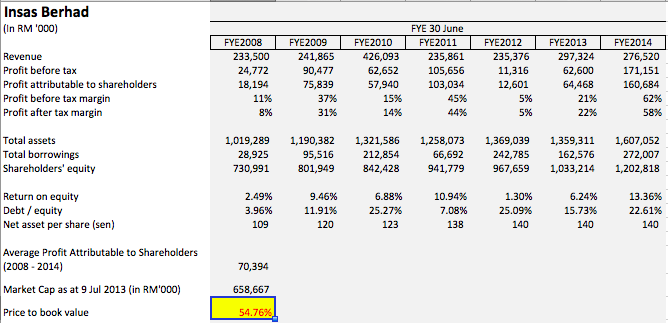
Is it not one of the most undervalued company by Price / Book Value - trading at 54.76% of its total book value?
If it is so undervalued, why is it then trading at such a valuation? No dividends, perhaps. The company in fact declared its first ever dividend of 1.3 sen last year (2013) and 1 sen each for subsequent 2 years.
Or more so the controlling parties, are contented (with what already have). To address the low price / NA, the management do some shares buyback - and in fact for certain period, they were aggressively buying back their shares. But those shares bought back were redistributed back to the shareholders in the form of share dividends - which makes me wonder on why do they do that. (I however feel that their buying back is the right thing to do rather than dividends.) Insas, should in fact do more buybacks and even at price of RM0.95 these are seriously attractive for buyback.
In terms of performance, as it mainly is an investment holding company in the areas of business which is very cyclical - stocks investment (marked to the fair value of investment), stock broking, some property investments, several IT related businesses, no one seems to be able to foresee what are the prospects or future profitability of these businesses. However, the management did manage to create value (albeit not fantastic) as shown in the growth of its total assets and equity below.
Frankly, I would not judge the company to be poorly run, but it is one of those companies which are just inaggressive where the controlling parties are just too contented with what they have. Once a while, they would have made some good investments as shown below, but these returns are kept at the group level and not shared with shareholders (usually in the form of dividends). Note: since these were written, the management has been much much more aggressive - issuing more funds to buy more businesses. They have been more aggressive in their moves i.e. investing into new companies.
One of the scenario which shows that the management have done some great work is as per below where the company has gained 80% over 3 years. These investments however are the ones which only comes once a while, and will not be contributing consistently to the company.
Part of the statement in Annual Report 2010
Last year, we reported that we made a sizeable investment in London in Chantrey House, a residential cum commercial property in the Belgravia area, a prime property location in central London. In conjunction with our UK partner, we took an equal interest in the investment amounting to 22.5 million British Pounds. Since we purchased that property, central London property prices have recovered strongly. Current prices for apartments in comparable locations are transacting at between 1,200 to 1,400 Pounds per square feet compared to our purchase price of 670 Pounds per square feet. We intend to hold on to this investment as we believe property prices should continue to rise in view of the low interest rate environment.
Part of the statement in Annual Report 2012
What is Insas core businesses then and where is its revenue and profit contribution from? Its main involvement is in the investment holding, trading and financial services and credit (money lending), and leasing (as shown below):
Investment holding as highlighted below is what they do with their cashflow, which means they trade stocks as well as buying bonds and other financial instruments:
Besides stockbroking, money lending and investments into several businesses, one noticeable investment is its associate stake in Inari, a semiconductor company which is doing extremely well. On paper, Insas' holding of 30% + warrants in Inari is already worth RM800 million as at 14 April 2015 (as compared to accounts where it is recorded at book value). Hence, the holdings in Inari is already higher than the market capitalisation of Insas and if one is to account the investments at market, the Net Asset / Share of Insas is more than RM2.50. (Is it not undervalued?)
It has also gone on to purchase the revived Ho Hup Construction, a counter which has a very interesting landbank in Sri Petaling. The property is being managed by the same party who manages Pavilion. Having said that, if it can do achieve a quarter of Pavilion is achieving, it should do well already. (It is different location though - very different)
For most part of its businesses, Insas are involved in mostly cash related trades (or businesses) which means they are liquid traded assets, hence the company should not be trading at that much below its NTA. It is not really a property company in which case the landbank may take a longer time to be disposed.
As many would have thought though (including me), Insas has been trading that way for ages, and the management is not going to change its way of handling the company. Insas has about 33,000 shareholders which means there are quite a number of holders whom are caught holding the stock for a very long time.
I do not think the management has taken the shareholders for a ride but they are surely not doing enough to take care of minorities interests.
Felicity (14 April 2015)
------------------------------------------------------------------------------------------------------
Investing for me, is about looking for great businesses. This however does not apply to everyone. Some may just want to search for companies that are undervalued to its book value. I do not specifically seek for those stocks. What I usually look for is a business which I can understand, comfortable with. Those that I can see and understand the potential - but those stocks may not be the most undervalued. In fact, it may not be undervalued at all, but as in business, you do not seek for just undervalue but good valuable companies is what you seek.
Most good businesses are usually not undervalued. Good businesses are usually trading at fair value. Seldom are we able to get them at prices which is way undervalued unless, we found those companies at its early stage.
To judge a company's undervaluation based on book value though, it is much easier. A company that is trading at below its book value (with some margin of safety) is presumed to be undervalued. This applies to one particular stock which I am going to introduce as below - Insas Berhad. This company should not be difficult to value as the type of holdings that it has are in the form of investments - largely stockbroking business, Inari Amertron, Ho Hup, Omesti and several other smaller investments.
Is it not one of the most undervalued company by Price / Book Value - trading at 54.76% of its total book value?
If it is so undervalued, why is it then trading at such a valuation? No dividends, perhaps. The company in fact declared its first ever dividend of 1.3 sen last year (2013) and 1 sen each for subsequent 2 years.
Or more so the controlling parties, are contented (with what already have). To address the low price / NA, the management do some shares buyback - and in fact for certain period, they were aggressively buying back their shares. But those shares bought back were redistributed back to the shareholders in the form of share dividends - which makes me wonder on why do they do that. (I however feel that their buying back is the right thing to do rather than dividends.) Insas, should in fact do more buybacks and even at price of RM0.95 these are seriously attractive for buyback.
In terms of performance, as it mainly is an investment holding company in the areas of business which is very cyclical - stocks investment (marked to the fair value of investment), stock broking, some property investments, several IT related businesses, no one seems to be able to foresee what are the prospects or future profitability of these businesses. However, the management did manage to create value (albeit not fantastic) as shown in the growth of its total assets and equity below.
Frankly, I would not judge the company to be poorly run, but it is one of those companies which are just inaggressive where the controlling parties are just too contented with what they have. Once a while, they would have made some good investments as shown below, but these returns are kept at the group level and not shared with shareholders (usually in the form of dividends). Note: since these were written, the management has been much much more aggressive - issuing more funds to buy more businesses. They have been more aggressive in their moves i.e. investing into new companies.
One of the scenario which shows that the management have done some great work is as per below where the company has gained 80% over 3 years. These investments however are the ones which only comes once a while, and will not be contributing consistently to the company.
Part of the statement in Annual Report 2010
Last year, we reported that we made a sizeable investment in London in Chantrey House, a residential cum commercial property in the Belgravia area, a prime property location in central London. In conjunction with our UK partner, we took an equal interest in the investment amounting to 22.5 million British Pounds. Since we purchased that property, central London property prices have recovered strongly. Current prices for apartments in comparable locations are transacting at between 1,200 to 1,400 Pounds per square feet compared to our purchase price of 670 Pounds per square feet. We intend to hold on to this investment as we believe property prices should continue to rise in view of the low interest rate environment.
Part of the statement in Annual Report 2012
I am also pleased to report that subsequent to year end, our 50% joint-controlled entity has accepted offer to sell the London’s Chantrey House property for £37.6 million, and the sale price represents a 80% capital appreciation over our original acquisition price 3 years ago. The sale, when completed, will generate free cashflow in excess of RM50 million to Insas.
What is Insas core businesses then and where is its revenue and profit contribution from? Its main involvement is in the investment holding, trading and financial services and credit (money lending), and leasing (as shown below):
Investment holding as highlighted below is what they do with their cashflow, which means they trade stocks as well as buying bonds and other financial instruments:
Besides stockbroking, money lending and investments into several businesses, one noticeable investment is its associate stake in Inari, a semiconductor company which is doing extremely well. On paper, Insas' holding of 30% + warrants in Inari is already worth RM800 million as at 14 April 2015 (as compared to accounts where it is recorded at book value). Hence, the holdings in Inari is already higher than the market capitalisation of Insas and if one is to account the investments at market, the Net Asset / Share of Insas is more than RM2.50. (Is it not undervalued?)
It has also gone on to purchase the revived Ho Hup Construction, a counter which has a very interesting landbank in Sri Petaling. The property is being managed by the same party who manages Pavilion. Having said that, if it can do achieve a quarter of Pavilion is achieving, it should do well already. (It is different location though - very different)
For most part of its businesses, Insas are involved in mostly cash related trades (or businesses) which means they are liquid traded assets, hence the company should not be trading at that much below its NTA. It is not really a property company in which case the landbank may take a longer time to be disposed.
As many would have thought though (including me), Insas has been trading that way for ages, and the management is not going to change its way of handling the company. Insas has about 33,000 shareholders which means there are quite a number of holders whom are caught holding the stock for a very long time.
As for its future, as long as it is into businesses of investing and stockbroking, it will continue to be the same i.e. pretty volatile. I feel that for it to move upwards i.e. closer to its Net Asset Value, the minority investors have to do something and voice out more so that the management take heed over the voices of the masses. Only then will it trade at its real value.
I do not think the management has taken the shareholders for a ride but they are surely not doing enough to take care of minorities interests.
Saturday, July 6, 2013
It's the BUSINESS and PEOPLE!
I have had several emails from first time investors on what is the most important thing for a first time investor. Now let me ask back - Why is there a stock market in the first place?
It is a place to allow entrepreneurs to raise funds for their businesses while allowing those with savings to participate in the growth of a company. Of course trading is allowed and stock market has become a very complex place. It has become a field for very smart people taking advantage of herd followers or apprentices who are just learning their trade. As in some of the shows (e.g. Star Wars) there are apprentices whom have become masters but yet there are apprentices who remain to be apprentices throughout their life or many in fact dropped out.
Stock market can be a place for hostile takeovers, more friendly mergers and acquisitions, fraud to take place and of course for some controlling shareholders, a place for them to treat the public company as their own despite the company being a PLC.
However, if one is to be involved in the stock market, the person should not lose sight of what stocks are for. It is in the stocks of the company where the shareholders are participating in the ownership or for growth and ultimately hoping for capital appreciation and dividends.
Hence, when one is buying a stock, he is buying a business or participating in the business. Given the choice to participate in a business, let me ask what does a person look for - the most important thing?
Trustworthiness of the management - One has to question whether you as the investor, do you trust the management? If you cannot trust the management despite how good or smart the manager can be, how can you invest in him / her? The manager can show you his success in managing or growing a business but some of them have taken shareholders for a ride. Let me ask the same question in another manner. Given that there is no intermediary to trade stocks and you are investing in him and the business in a private market (hence most of the time the most logical way to get back your return from investment is from dividend or sell back to the major shareholder) - would you invest in his pitch, if you do not trust the person?
This goes back to knowing the business and people behind the company. If we are not able to contemplate what the company does, can we be for sure that the business will do good in the future. We rely on others? Professional managers - mutual fund managers, trust fund managers? Yes. But, again the same thing - for many who invest or put their money with a unit trust fund, do you even know the fund manager or their track record, or is it just because we do not know where to put our money and be that follower mentality? We trust on just merely the word - a unit trust fund (with license)? Do you know their track record?
Back on investing into a company - to find out about the managers and the business, it can be a daunting task. How do we check out about the management. Read! And learn from experience as well as other people! This place can be one of the place :)
However, when I write I have to be careful as I can only say based on facts but a lot of times, the managers whom we have doubts on - you will have to have the gut feel based on what you see (from Annual Report) and based on their track record. What they have done before, or rather what have they done before...I cannot explain this in words sometimes, frankly. Its a gut feel.
Sometimes, as an investor, I myself lose focus and concentrate on just the numbers (i.e. data, ratios, trend, profit track record). But investment is much more than that. If it is just numbers, then it is very easy. But how do we explain on companies with 30x PE, just average growth, but yet has gained the trust of many investors - current or prospective?
Stocks is about business and people. Start learning on that, read on that - think, see, hear, mix with (the right) people whom have proven some success in stocks investment. If the person do not like to read, listen watch and think about business, he / she will not be able to do well in investment. Reading and analysing financial records can obviously help (this should not be missed), but surely it is not the only thing to look for.
It is a place to allow entrepreneurs to raise funds for their businesses while allowing those with savings to participate in the growth of a company. Of course trading is allowed and stock market has become a very complex place. It has become a field for very smart people taking advantage of herd followers or apprentices who are just learning their trade. As in some of the shows (e.g. Star Wars) there are apprentices whom have become masters but yet there are apprentices who remain to be apprentices throughout their life or many in fact dropped out.
Stock market can be a place for hostile takeovers, more friendly mergers and acquisitions, fraud to take place and of course for some controlling shareholders, a place for them to treat the public company as their own despite the company being a PLC.
However, if one is to be involved in the stock market, the person should not lose sight of what stocks are for. It is in the stocks of the company where the shareholders are participating in the ownership or for growth and ultimately hoping for capital appreciation and dividends.
Hence, when one is buying a stock, he is buying a business or participating in the business. Given the choice to participate in a business, let me ask what does a person look for - the most important thing?
Trustworthiness of the management - One has to question whether you as the investor, do you trust the management? If you cannot trust the management despite how good or smart the manager can be, how can you invest in him / her? The manager can show you his success in managing or growing a business but some of them have taken shareholders for a ride. Let me ask the same question in another manner. Given that there is no intermediary to trade stocks and you are investing in him and the business in a private market (hence most of the time the most logical way to get back your return from investment is from dividend or sell back to the major shareholder) - would you invest in his pitch, if you do not trust the person?
This goes back to knowing the business and people behind the company. If we are not able to contemplate what the company does, can we be for sure that the business will do good in the future. We rely on others? Professional managers - mutual fund managers, trust fund managers? Yes. But, again the same thing - for many who invest or put their money with a unit trust fund, do you even know the fund manager or their track record, or is it just because we do not know where to put our money and be that follower mentality? We trust on just merely the word - a unit trust fund (with license)? Do you know their track record?
Back on investing into a company - to find out about the managers and the business, it can be a daunting task. How do we check out about the management. Read! And learn from experience as well as other people! This place can be one of the place :)
However, when I write I have to be careful as I can only say based on facts but a lot of times, the managers whom we have doubts on - you will have to have the gut feel based on what you see (from Annual Report) and based on their track record. What they have done before, or rather what have they done before...I cannot explain this in words sometimes, frankly. Its a gut feel.
Sometimes, as an investor, I myself lose focus and concentrate on just the numbers (i.e. data, ratios, trend, profit track record). But investment is much more than that. If it is just numbers, then it is very easy. But how do we explain on companies with 30x PE, just average growth, but yet has gained the trust of many investors - current or prospective?
Stocks is about business and people. Start learning on that, read on that - think, see, hear, mix with (the right) people whom have proven some success in stocks investment. If the person do not like to read, listen watch and think about business, he / she will not be able to do well in investment. Reading and analysing financial records can obviously help (this should not be missed), but surely it is not the only thing to look for.
Subscribe to:
Posts (Atom)


