By now we would have read that the FAA downgrade of Malaysia's aviation safety rating has nothing to do with the airlines, but rather on the regulatory functions. This has caused concerns over some of us, when does not know how it is going to impact our aviation sector. One director went further by saying that the FAA would not have done check on us until Airasia X had its flight to Honolulu. In fact, since 2003, the FAA had not had a check on us. Is it a blame on Airasia X, or he is just saying a fact.
That same person runs Time Dotcom. I think he may have said a factual matter, but does it matter? Should it be because of a flight route initiated to Honolulu, we should now be putting our house in order - safety that it?
As a customer to airlines and the aviation industry, we have been bombarded by continuous price increases over the last few years. We created MAVCOM in 2015 which some say overlaps the function of CAAM. We even pay RM1 to support MAVCOM each time we take a commercial flight. I am sure given the continuous increase in passenger traffic, they should be sufficiently covered financially. It is ironic, that the users are the one that usually covers the expenses of these guys whereas their functions should be improving the infrastructure and profile of Malaysia as an aviation and tourism hub. The winner has been MAVCOM and the country but the users are the one who pay.
When we have CAAM whose salary scale follows the government and it is supposedly insufficient to entice the experienced people to stay, we have MAVCOM as well, whose role is still unclear.
How does this impact Malaysia? We have built a solid industry. I think it is time to be more vigilant and have the input from the right group of people for our aviation to grow.

Wednesday, November 13, 2019
Saturday, November 9, 2019
Surin Upatkoon's new holding structure in WCE: Cleaner, better
I have been asked on the new structure for the second largest shareholder of WCE: Surin Upatkoon. What are the impact? Is he relinquishing his stake in WCE etc.?
Well, as a start his original stake in WCE is through several organizations i.e. a complex holding via 5 companies namely, Cypress Holdings Limited, Pinjaya Sdn Bhd (Malaysia), Hanton Capital Limited, Cedar Holdings Limited, Kularb Kaew Company Limited

The shareholding was as depicted below:

With the exercise, it seems that the shareholding is now cleaner i.e. as below:

As in the announcement, Hanton Capital, a company resided in a tax haven, Virgin Islands has sold its 99.9% stake of Pinjaya directly to Tan Sri Surin Upatkoon.
Well, I prefer this as it is cleaner and the actual shareholder is now back into Malaysia.
What makes it change then, as sometimes business people would prefer a more complex structure.
That could be due to several reasons:
Well, as a start his original stake in WCE is through several organizations i.e. a complex holding via 5 companies namely, Cypress Holdings Limited, Pinjaya Sdn Bhd (Malaysia), Hanton Capital Limited, Cedar Holdings Limited, Kularb Kaew Company Limited

The shareholding was as depicted below:
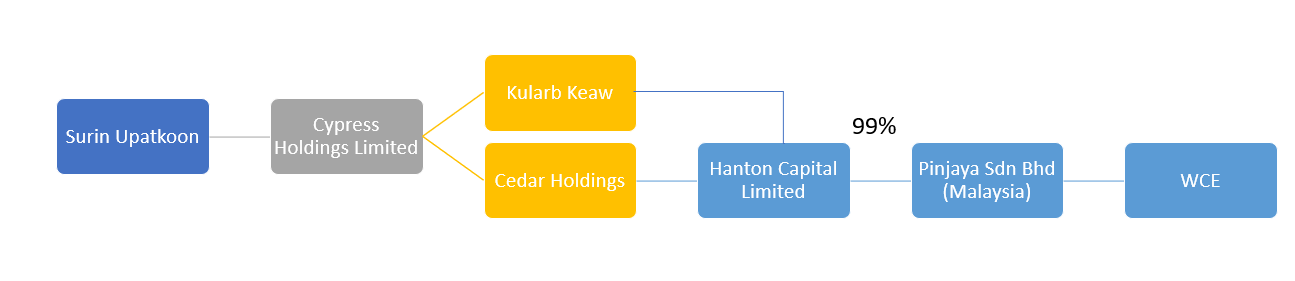
With the exercise, it seems that the shareholding is now cleaner i.e. as below:

As in the announcement, Hanton Capital, a company resided in a tax haven, Virgin Islands has sold its 99.9% stake of Pinjaya directly to Tan Sri Surin Upatkoon.
Well, I prefer this as it is cleaner and the actual shareholder is now back into Malaysia.
What makes it change then, as sometimes business people would prefer a more complex structure.
That could be due to several reasons:
- He just want a cleaner structure (surprisingly)
- Because of the rights issue, he may use bank financing to fund part of his subscription. Banks usually prefer a cleaner structure especially when they are the one financing the purchase.
- If one is to notice above, the holding is brought back to Malaysia. As toll business has gone riskier due to the threat of government's plan of toll elimination, I believe foreign financiers are more reluctant to finance it. The financing may be dependent on local banks and they do not want to be seen financing a company with complex web of structure.
If Surin relinquishing his holdings in WCE? I think not at all, especially when he privatised MWE partly because of this.
Is there an impact on WCE? Minimal. But I prefer this structure better.
Free warrants and its futility
Free warrant feels like this. If we give it the first time, the children (meaning the ones that are still immature) will like it - feels like free ang pows. Precisely. But soon, the children will also realise that the free ang pows that we give is just a paper money which is worth less when we print our own money.
If we give out too many times just like what Vivocom did - in total 5 times and see what happened to its share price. Vivocom used to be the master of the free warrants and seems like one person - a sifu - is a biggest proponent of free warrants.
I wrote an article about Vivocom, during its most active period.

What is free warrant?
It is printing money. Only one country in this world can do it in large quantities and can get away with it. Uncle Sam. Even then, they are rethinking.
One person used to say this,
You can fool all the people some of the time, and some of the people all the time, but you cannot fool all the people all the time.
But it seems that recently, Buffettology is also under fire by some people. Nothing wrong and harmful.
If we give out too many times just like what Vivocom did - in total 5 times and see what happened to its share price. Vivocom used to be the master of the free warrants and seems like one person - a sifu - is a biggest proponent of free warrants.
I wrote an article about Vivocom, during its most active period.

What is free warrant?
It is printing money. Only one country in this world can do it in large quantities and can get away with it. Uncle Sam. Even then, they are rethinking.
One person used to say this,
You can fool all the people some of the time, and some of the people all the time, but you cannot fool all the people all the time.
But it seems that recently, Buffettology is also under fire by some people. Nothing wrong and harmful.
PLUS's press statement shows they are out of touch with their customers
PLUS largely operates along the North-South Highway and also the urban areas where its highway passes through Damansara right down to Klang (NKVE) while its Elite Highway passes through part of Shah Alam and connects to KLIA/KLIA2 from Damansara. PLUS obviously has the best highway in the country besides LDP in the urban areas.
Recently, it came out with a practice by not allowing motorists to do their top-up through its booths but instead pushing the motorists to top up counters at various counters at the side of the highways. I am not against the move as it does smoothen the traffic as queues do create unnecessary traffic along the toll booths. However on the other hand, practices like this creates complains from the toll users as some of them could not use the convenience of the booths for top ups, whereas they have to stop at stops to do the top ups.
The CEO of PLUS, came out and defended the company's move as it claims that motorists, due to this practice, top-up a higher amount each time whenever on average. It sounds as the right thing to do. However, if we try to understand the reason for some of them to do micro top-ups of RM10 and RM20, we can see and understand the financial situation of these people. A lot of these guys are also Grab or e-hailing drivers. In a few instances, the Grab drivers even asked me for cash to top up their pre-paid cards.
I think in many cases nobody wants to do micro top-ups if they can afford to but they just do not want their money to be tied down to the cards. That's what it is, in general.
Hope that a large company like PLUS can be more empathetic.
Recently, it came out with a practice by not allowing motorists to do their top-up through its booths but instead pushing the motorists to top up counters at various counters at the side of the highways. I am not against the move as it does smoothen the traffic as queues do create unnecessary traffic along the toll booths. However on the other hand, practices like this creates complains from the toll users as some of them could not use the convenience of the booths for top ups, whereas they have to stop at stops to do the top ups.
The CEO of PLUS, came out and defended the company's move as it claims that motorists, due to this practice, top-up a higher amount each time whenever on average. It sounds as the right thing to do. However, if we try to understand the reason for some of them to do micro top-ups of RM10 and RM20, we can see and understand the financial situation of these people. A lot of these guys are also Grab or e-hailing drivers. In a few instances, the Grab drivers even asked me for cash to top up their pre-paid cards.
I think in many cases nobody wants to do micro top-ups if they can afford to but they just do not want their money to be tied down to the cards. That's what it is, in general.
Hope that a large company like PLUS can be more empathetic.
Thursday, October 31, 2019
What Paul Krugman says about debt
Paul Krugman, the controversial Nobel Prize economist, who coincidentally penned an article about capital control and advice Asian countries on the matter one day before Malaysia had its capital control on 1 Sep 2018 - and the rest is history - politically and economically for Malaysia.
He has this to say about debt and its misconception (piece written on The New York Times) and I think this has its relevance to the Malaysian economy today although it was pointed towards the US.
----------------------------------------------------------------------------------------------------------------
People still don’t understand debt
By Paul Krugman
Opinion Columnist (29 Oct 2019)
Today’s column is about our trillion dollar deficit, which nobody seems to care about. The thing is, this lack of concern is justified: There’s no good reason to believe that the current budget deficit is doing significant harm.
What did do a lot of harm was the deficit hysteria that dominated establishment discourse the last time we had a deficit this big, which also happened to be a period during which the economy was deeply depressed, and the stimulus from deficit spending was actually a good thing. It should have been obvious that obsessing about deficits in 2012 was a huge mistake. What’s relatively new — and something I couldn’t get into at length in the column — is the realization that government debt isn’t much of a problem even at full employment.
One reason people find this hard to understand is that they make an analogy between the nation as a whole and an individual family. This leads to sober-sounding warnings that budget deficits amount to stealing from our children, in the same way that spendthrift parents are squandering their heirs’ inheritance.
This analogy, however, is all wrong. Debt is money we owe to ourselves — that is, for the most part it obliges one group of Americans, taxpayers, to make payments to another group of Americans, bondholders. It doesn’t directly make the nation poorer, at all. (O.K., there’s a small caveat: some debt is held by foreigners. But it’s not quantitatively important.)
Now, there might be indirect ways in which debt makes us poorer. To pay interest, the government might have to spend less or collect more taxes than it would have otherwise. And this could hurt growth — for example, high taxes could reduce incentives to produce and invest.
What economists have come to realize, however, is that even these indirect costs of debt may be negligible.
Why, after all, must a government raise taxes to deal with a higher level of debt? The usual answer is that if it doesn’t, the debt will snowball: the government will have to pay more in interest, which will cause the debt to rise further, leading to even more interest payments, and so on.
But nobody cares about the absolute value of debt; what matters is the ratio of debt to the tax base, which for the federal government is basically the whole economy, i.e., G.D.P. And a rise in the debt/G.D.P. ratio doesn’t snowball — it melts! Why? Because the interest rate on federal debt is normally lower than the economy’s growth rate.
He has this to say about debt and its misconception (piece written on The New York Times) and I think this has its relevance to the Malaysian economy today although it was pointed towards the US.
----------------------------------------------------------------------------------------------------------------
People still don’t understand debt
By Paul Krugman
Opinion Columnist (29 Oct 2019)
Today’s column is about our trillion dollar deficit, which nobody seems to care about. The thing is, this lack of concern is justified: There’s no good reason to believe that the current budget deficit is doing significant harm.
What did do a lot of harm was the deficit hysteria that dominated establishment discourse the last time we had a deficit this big, which also happened to be a period during which the economy was deeply depressed, and the stimulus from deficit spending was actually a good thing. It should have been obvious that obsessing about deficits in 2012 was a huge mistake. What’s relatively new — and something I couldn’t get into at length in the column — is the realization that government debt isn’t much of a problem even at full employment.
One reason people find this hard to understand is that they make an analogy between the nation as a whole and an individual family. This leads to sober-sounding warnings that budget deficits amount to stealing from our children, in the same way that spendthrift parents are squandering their heirs’ inheritance.
This analogy, however, is all wrong. Debt is money we owe to ourselves — that is, for the most part it obliges one group of Americans, taxpayers, to make payments to another group of Americans, bondholders. It doesn’t directly make the nation poorer, at all. (O.K., there’s a small caveat: some debt is held by foreigners. But it’s not quantitatively important.)
Now, there might be indirect ways in which debt makes us poorer. To pay interest, the government might have to spend less or collect more taxes than it would have otherwise. And this could hurt growth — for example, high taxes could reduce incentives to produce and invest.
What economists have come to realize, however, is that even these indirect costs of debt may be negligible.
Why, after all, must a government raise taxes to deal with a higher level of debt? The usual answer is that if it doesn’t, the debt will snowball: the government will have to pay more in interest, which will cause the debt to rise further, leading to even more interest payments, and so on.
But nobody cares about the absolute value of debt; what matters is the ratio of debt to the tax base, which for the federal government is basically the whole economy, i.e., G.D.P. And a rise in the debt/G.D.P. ratio doesn’t snowball — it melts! Why? Because the interest rate on federal debt is normally lower than the economy’s growth rate.
Subscribe to:
Posts (Atom)