Showing posts with label Jobstreet. Show all posts

Monday, December 5, 2016

Mark Chang's offer of JCBNext at RM1.20

I no longer hold JcbNEXT (formerly Jobstreet) and do miss a great business and management. Although there are similar traits in Jobstreet and MYEG in terms business nature, certain moats, the management of the 2 companies are different. One care for its shareholders, the other more of its own pockets - not going to tell which is which but for you to find out!

I just would like to comment on JCBNext towards its offer to purchase all its shares at RM1.20. I do not think it is its intention to delist or make purchases all its shares from the minority shareholders. The offer is out of the requirement under the SC guidelines.


As shown  in the red boxes above, the major shareholder has acquired a 20.17% stake from SEEK, to whom Jobstreet.com was sold to. Since the group has now own more than 50% of JcbNEXT, it is obliged to offer the same offer to all other shareholders. I do not think JcbNEXT is to delist its company.

However, as the deal that Mark Chang has gotten is pretty sweet i.e. RM1.20 while some of the people have claimed that the actual value of JcbNEXT is much more than the RM1.20 value, I feel the right thing to do is to offer the sale of RM1.20 by SEEK to shareholders rather than a single individual takes the entire deal up at an attractive price. This means the 20.17% should have been offered to all shareholders rather than 1 individual.

Sorry to the main shareholder of JcbNEXT (Mark) but this is the right thing to do. All food should be offered on the table and not for one to just take and eat it.
(You know what, in his interview with BFM, Mark Chang has mentioned he wanted to invest into companies that have social impact to the community - this is one as largely minority shareholders are considered the social group, to me as most shareholders just want their investment to see through)

Friday, December 19, 2014

Fully sold Jobst

This has been a very good stock, business and very humble management that takes care of its shareholders. However, as it is not very clear on its future business after selling a very good business, I have decided to clear all of Jobstreet's stocks.


Couldn't have found a better management.


Tuesday, December 2, 2014

Shifting portfolio

The past 2 trading days have seen huge drop especially to O&G companies. Not surprising, other stocks are getting some hit as well. With that, I am making some change to my portfolio. It is still a boring change though with the switch from Jobstreet to Keuro. (Yes, I am buying same same company.)

Jobstreet has already sold its main business to Seek and I do not see much upside anymore. The most it can go is probably to RM3.00.


Keuro, on the other hand I see huge potential. I have figured out that perhaps the holding of 40% in Bandar Rimbayu alone for Keuro could potentially be worth around RM0.9 billion at least. Yesterday, Gamuda had bought a piece of land adjacent at RM35 per sq ft and that is an agricultural land which will need some additional spending and work on (calculation below). Hence, if anyone is claiming that the purchase of Canal City land by Ecoworld at RM35/sq ft is expensive - it probably is not. Tropicana got it cheap.

Calculation of purchase price by Gamuda on an agri land near Kota Kemuning
Purchase price of - RM392,172,858.00
Total hectares - 104.1 hectares = 11,205,220 sq ft
Price per sq ft - RM35 per sq ft

Calculation on Rimbayu
Total acre - 1878 acre
Total sq ft - 1878 x 43,560 = 81,805,680 sq ft
Discount - 20% for an associate stake
Price per sq ft - RM35 per sq ft
Total Value - 81,805,680 x 80% x RM35 x 40% = RM916,223,616

At current price, Keuro is trading at around RM1.05 billion where the 40% ownership of Rimbayu is probably already worth that much. Additionally, I still think that the West Coast Expressway will be worth more than the Rimbayu stake. The drop in oil and other commodities may even help Keuro in having the construction costs lower as there is somewhere that I have encountered that in building of roads, around 70% are in the raw materials - cement, steel, bitumen (petroleum by products). Do check out where the prices of these items have been heading over the last year. I am not sure for Keuro's case, would raw materials comprise 70% of the costs. Any civil engineers here that can help to clarify? Do note that Malaysian government is taking up the costs on land acquisition in this project.

Hence, I have made some adjustments to the portfolio.


Wednesday, August 20, 2014

Jobstreet's revised sale price to RM1.89b

Just yesterday, Jobstreet announced a revision in its sale price to Seek which below is self explanatory.


The special dividend hence is being revised to RM2.62.

One should note the following:

- post dividend distribution, the Net Asset value of Jobstreet will still be around RM0.40 per share;
- the sale has yet to be approved by Singapore's anti-competition body. Expected decision to be before 31 October 2014.
Whether I am confident of the approval? I would say yes, although this is taking longer than expected. Nevertheless the longer approval is a blessing in disguise as this allows change in purchase price by Seek.com.

Remember my article on undervaluation of Jobstreet by Seek.com. This seems to be a reprieve.

Tuesday, July 15, 2014

MOL Online's IPO in Nasdaq: Must be easier sell in US

Frankly, I do not have a good feel of the company. I remember many years ago, MOL Access Portal was delisted because the company was not going anywhere despite it being an online payment system company and it was mainly selling credits at cybercafes for mainly those playing online games.

I could not really see and vision how it can grow much. Then few years ago, we hear of it buying Friendster and that was the smart financial dealing when Friendster's patents was used as a negotiation tool for a small portion of Facebook's shares. It must have been worth a lot now i.e. to the tune of at least a billion ringgit now that Facebook is worth USD172 billion (15 Jul 2014).

However news keep on prompting us that MOL Online is doing a hundreds of millions fund raising first locally and over the last few years it seems they have moved to Nasdaq. Frankly, I would have thought this company would have made at least RM50 to more than RM100 million in profits as anything less, it would not be Vincent Tan worth, or at least may not be able to raise that few hundreds of millions. It is not. At last the financial numbers are out with news claiming that it is raising USD300 million. For it to raise USD300 million, the company must be worth at least USD1.5 to USD2.0 billion as they would probably only release 20% of their shares? Maybe more, I do not know. But let me know from the below numbers, is MOL worth that much?

MOL's last 3 years P&L. Click to enlarge
In Malaysia, I would not have that buy in, as I do not really have a strong vision of how much growth the company can have. Already, it has been around for many years and online payment company has many competition. The modest operandi to operate this is not to sell through 7-ELeven or any shops but I have always thought the best way is to convert points is through your e-banking systems, ATM machines etc. Hence, I thought the winners would be the banks. If the winners are through the purchases at 7-Elevens and petrol stations, MOL would have made that RM50 million or more profits at least by now. This is because the reach that MOL and through Vincent Tan's retail reach are easy and plenty, especially in Malaysia. Banks would still be the winners as they have the best reach and marketing money. MOL would still be far behind.

Currently, MOL is already operating in many countries - Malaysia, Thailand, Vietnam, Philippines and very recently it bought some operations in Turkey (we Malaysians like Turkey now) and Brazil.

Quarterly income statement for last 8 quarters. Click to enlarge
If you notice the last 8 quarters results, the main growth was over the last 4 quarters. You see, if I have loads of cash, I can make more cash as through acquisition, I can show that the company and business grows by leaps and bounds but these are not organic growth. See above's image. If the revenue is big for especially businesses with thin margins such as MOL's business, more magic can be squeezed for profits. Why am I seeing that it is starting to make much more profits over the last few quarters when the business has been around for more than 10 years? The cashflow as below may be better reflective of its actual ability, I hope.

Cashflow for last 3 years - Click to enlarge

If your read below, most of the growth are through acquisition recently i.e. Thailand, Brazil, Turkey etc. Usually, revenue will also increase especially prior to any IPOs.

Click to enlarge

If these numbers are not that fantastic, how can it be worth more than RM4 billion as it would have been. Well, I am also reading Janet Yellen's remark during her statement to Capitol Hill today, "In equity markets, the Fed saw signs of increased risk-taking limited to small-cap stocks and biotech and social media shares." 

MOL is not under any of that category though, i.e. social media or biotech - maybe it is not risky then?

However, I personally think that the space it is in is hugely competitive. The barrier to entry is huge and it will not be able to compete against many free platforms such as banks platforms, ATMs etc. when they are providing it as a service. In other areas it is competing against the likes of Whatsapp, Wechat etc. No way it can be dominant as this space is hugely convulated.


Monday, July 14, 2014

Is Jobstreet underpriced by Seek?

How can a footballer which is banned for four months, aged 27 years old be sold still at the 3rd highest price paid for a footballer ever? This is because he is one of the best despite the risk that Barcelona is taking with him potentially biting again - yes I am talking about Luis Suarez. It is very hard to find a player similar, barring the risk of further suspension on him if he bites again. Barcelona knows that they have to pay to get the best.

To get the best, you have to pay a high price, higher than fair. For a below average company, one should pay below average PE. For an average company, it should be priced at average PE. And for a top company, an above average price earning should be paid for. This is despite the price is at 29x PE. And this is what the Jobstreet's management did not negotiate well, despite they have some of the dream team of Malaysian best brains in its board. (And I am not saying Jobstreet bites)

For Seek to pay 29x PE and eliminate competition in many South East Asian countries, this is a dream come true. For a while, Jobstreet and Jobsdb are competing mainly as the top two in many countries - Malaysia, Singapore, Indonesia, Philippines.  As a football team, imagine you have all the best players after you have bought your competitors best. 

In fact - the football analogy may be different from business. In football, you can still buy many good players, to replace one top player, but in business you cannot just throw say RM1 billion to recreate another Jobstreet. It just does not work like this! And if you just do this, it will take many years - not immediately.

One cannot recreate a dominant company just like that and Jobstreet dominates together with Jobsdb in most of the countries they are operating in.

Note: I am bringing this up because Jobstreet is renegotiating the selling price with Seek.com as it seems that there is delay in Competitive Companies Singapore in approving the deal due to anti-competition law. And it seems that if the deal extends beyond July 1, 2014 - there is a right for Jobstreet to renegotiate or walk away from the deal. To me, the thing that Jobstreet is doing is right but it may be too eager to sell. It has to negotiate thinking that Seek is eliminating a key competitor - not based on fair value as in what most investment bankers will use i.e. comparative acquisition multiple.

Monday, May 5, 2014

Jobstreet's dividend

For those whom have enquired about Jobstreet's dividend from the sale of the core business to Seek.com, here is a little clue - estimated to be RM2.40.


As for the Net Asset value of the shares, post dividend distribution - RM0.3572 per share.


Thursday, March 13, 2014

Large Jobstreet block sold

Last week, prior to the dividend cut off date, there was a single day when Jobstreet had a very large transaction. I was sort of expecting Fidelity to be selling and it was true that the large block of some 14 million shares in a day. Who has been buying is unknown as well as why Fidelity has been selling is also unknown.

The only thing that I am guessing is that since Fidelity owns a substantial block of Seek (as shown below), I would guess that it does not want to own as many stocks in Jobstreet during a period where it is critical to get shareholders approval for the deal. As it is, Seek already owns some 22.2% of Jobstreet, it does not help when Fidelity also owns a substantial block of the target. I am not sure if Fidelity is allowed to vote among the shareholders meeting although the submission papers does not mention that. Whatever is known is that for the deal to be approved, it will require 75% shareholders approval (with Seek abstain from voting). 75% is substantial.

The large chunk of Jobstreet's shares were sold at RM2.41 prior to dividend (ex-date 10 March). The parties whom bought the large block from Fidelity off market would have made a handsome gain over a short period of time if Jobstreet is worth more than RM2.60. That's how the rich makes money, I guess!

Fidelity's holding of Seek.com

Tuesday, March 4, 2014

Where did it go wrong? (Pls read comments as well)

Sometimes in an investment, one should have some time to really look through in detail. Time was something I did not really have in the past month, but yet I did some investment - Jobstreet.

In any case, I have looked at the continued dwindling of Jobstreet, even after my purchase. It is now trading at RM2.41 (4 Mar 2014) - be prepared for it to drop further, it seems.

Only after the drop, I decided to read in more detail of the entire issue - this is a mistake, one should not do this! One should look and look, to be accurate, read again.

Anyway, this is what I have found - based on the information that is available.

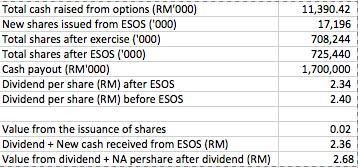
The above shows the ESOS that is outstanding as at 31 December 2013. That would add to the number of shares after new shares are issued to the minority shareholders which Jobstreet, the holding company does not own 100%. In the sale of its business, Jobstreet is doing an exercise and selling the business in its entirety - 100% of all the subsidiaries. Hence, it will need to issue new shares in exchange for the shares in Jobstreet Vietnam, Philippines and Indonesia it does not own. After the purchases, the total number of shares that are outstanding would have increased to 708,244.


However, this does not include the ESOS that can be exercised by the ESOS holders. Hence, I have done a simple calculation as below and try to explain at my level best.

Table 3

What the above Table 3 depicts is that how many shares would be outstanding assuming that all the ESOS shares are exercised (which I think would be the case as the ESOS are all in the money).

How much dividend would be paid out per share after the full exercise of the ESOS? RM2.34.

However, as the ESOS would involve new cash being injected for the subscription, there would be a net addition of RM11.39 million of new cash from ESOS (first line of Table 3). That translates to RM0.02 per total shares (RM11,390 / 725,440) of Jobstreet.

Based on what's left after the dividend, assuming it gets the full value of its Net Asset Per share of around RM0.32 - RM0.33, the intrinsic value would be somewhere around RM2.68. (Note that I normally do not try to guess the intrinsic value of company except for this situation, which is possible)

I am trying to trust that the management would have concluded the sale by 2nd quarter of 2014 and that is some 4 months down the line at the most. With that, I am now thinking that the currently traded price has a decent what you call "Margin of Safety".

Note: Of course, I am not able to know how many new ESOS would be added between 1 Jan 2014 until now as that has never been revealed by the management of Jobstreet. Of all the good things, that the management of Jobstreet had done, this piece of information is not complete and it is forcing the shareholders to do their own calculation - not right!

Anyhow, I do not really care about the PN17 in this case as it is about the lack of strategic business than it in financial difficulties.

Thursday, February 20, 2014

Jobst: One last chance to milk the cow? (Revised with inputs from others)

Jobstreet just announced that it has been offered by Seek to buy Jobstreet's online job posting business for RM1.73 billion. With that, Jobstreet will distribute RM1.7 billion in the form of dividends to shareholders. After the sale and distribution, Jobstreet will be left with the below.


The above could still be worth around RM0.32 to RM0.35 although the large part of Jobstreet has already been sold off.

Through my calculation, there are about 650.5 million (revised to 708 million) of outstanding shares inclusive of employees options, which some have yet to be exercised. At distribution of RM1.7 billion, that comes to about RM2.40 of dividend to be distributed to shareholders.

At its current traded price of RM2.54, the dividend distribution of RM2.40 and RM0.0175 (interim dividend) together with RM0.32 of net assets that's left, Jobstreet is trading at 7% discount - and don't forget, I am getting a huge chunk of cash - i.e. RM2.4175 per share in say within 6 months time upon completion of the sale.

7% discount in 6 months comes to about 14% return annualised - which is decent, and I do not know why investors are selling.

Although I am sad that Jobstreet is selling its main business, this is still one last opportunity to make some decent return. Hence, I just bought a small sum of 4200 units.


Thursday, May 23, 2013

Jobstreet continues to amaze (Updated)

I am not saying this because I own this stock. In fact I am upset cause I did not buy more. Sometimes when there are doubters, I tend to pull back (not blaming anyone but myself). The business of Jobstreet continues to do well, now perhaps not in one country but 3 countries - Malaysia, Singapore and Philippines. It is not a "jaguh kampung" anymore.

See below:


Each of the 3 countries I mentioned exceeded RM10 million in revenue for the first quarter 2013. The business is easy but hard to quantify. As I have said before, and those whom have read my blog in this company would probably be tired (sorry) of me continuing to comment on Jobstreet (nope, I am not paid, in fact I am only a small shareholder), but it is not easy to comprehend. Me myself had doubts before. Just see the previous blog and its comment.

We have doubts because of the competition at hand. There is again Star (as I see it going nowhere yet), LinkedIN and perhaps many more. I have invested into Monster, it is a different "Monster", I can tell you that - don't know why. LinkedIN? I doubt so as LinkedIN itself would not be able to get so much market share. Perhaps the soft job market still in US and Europe.

Now, based on the above segmental, look at below for the previous corresponding quarter comparison:


Almost every ringgit earned is a ringgit gained. As long as it grows its revenue, it will perform amazingly.

I do not know how much the company spends on marketing costs, but the main strength now is the database which in the balance sheet you do not see. What do you see in the balance sheet? Besides to tell us that it has a strong balance sheet, nothing much...


Currently, as the company continues to be on the uptrend, its Price to Book Value will get widened. The cash that it holds will cover its expenses for slightly more than a year, I think. And that's it, nothing much to analyse.

Until now, Jobstreet has its policy of distributing 50% of its profits as dividends. It has just upped that to 75%. It has made some mistakes of using the additional cash that it had by investing into some companies. While some of the made sense, i.e. investing into the dotcom job search companies like in Taiwan, there are others which are not bringing much returns. The monies that Jobstreet invested into are the ones boxed in red above. I am just glad that they are preparing to share more of its profits in the form of dividends.

The beauty is in the cashflow, hence dividends (be prepared for more) as well as the P&L. I should have bought more...

Tuesday, December 18, 2012

Jobstreet: Share buyback is the name of the game

What do you do when you have funds that you do not know what to do with. Either dividend or buyback. I like buyback especially when the shares are cheap presumably.

Well, this is what Jobstreet did. 2 major buybacks in less than a month. 3 million shares was bought in late November. I much like this than when they bought Innity.


And another 2.6 million stocks today, making a total 1.75% of Jobstreet's shares being bought back in these 2 transactions.


All in all Jobstreet has spent RM12.8 million on this. The thing is that, I believe in the two transactions, the selling are just done by 2 shareholders who hold large blocks. Otherwise, it would not be done in such manner.

The difference between dividend and share buyback is that while dividends provides returns to the shareholders immediately, a share buyback done right would provide the impetus for creation of better value per share in the long term.

Coincidentally, on a larger scale, Berkshire Hathaway did the same by buying back USD1.2 billion worth of stocks in a single transaction just last week.

Monday, November 26, 2012

What I see in Jobstreet...

Besides the worry in Linkedin as a competitor which to me is overdone, this is what I see in Jobstreet - its contributions from its oversea's operations particularly Philippines. From this year onward, revenue from Philippines will probably exceed its Singapore's revenue - all the while its second largest market.


Look at the table above as compared to its FY2011's geographical contributions below. From this, we know that Jobstreet is not a "jaguh kampung". It has found secret formula for success in Philippines, hence telling that this is not a one-hit wonder. Revenue in Philippines has grown at high double digits percentage and it seems that it could have still continued to do so. Apparently, Indonesia is a high double digit growth market as well although it is categorised under "Others" for now.


This is important. Another factor, despite Linkedin having a representative sales office in Singapore, revenue in Singapore for Jobstreet nevertheless continues to grow - although slower than Philippines. Hence, all the fear of loss in revenue in the job advertisement space should be concentrated on the print media rather than online jobs posting companies such as Jobstreet and SEEK.

Low assets

What are Jobstreet's assets? The jobseekers who posted their resumes in the company's database as well as the employers that are looking for employees. These, you can't see in the balance sheet. Unlike the traditional print media companies, there are no printing presses as owned by Star, huge factories like those owned by F&N etc.  Hence, if you look at the balance sheet of these companies, they basically are just cash, some receivables as well as some intangibles. However, as in previous post, I have mentioned of Jobstreet expensing off all their R&D expenses - which is a good thing looking forward. The free cash flow that are received, a huge sum are actually redundant if they do not use them wisely.

There is no need for building huge factories or distribution channels except for office for staffs. The more successful or the larger the databases, the more job-seekers and employers are going to use them. That's the beauty, as in a way you can say that it is almost free marketing for Jobstreet.

This is also why Jobstreet is able to pay out higher dividends and keep a very lean balance sheet. In fact, for Jobstreet, what you want to see is how efficient they use their equity as in ROE overtime. As an investor though as it has proven to me successful, I am willing to let them build the market they intend to target such as the Philippines and Indonesia as well as Vietnam.

Similar to Linkedin's as well as Facebook's or even Jobsdb or any of the competitors per se, these are never heavy assets companies.

Is Linkedin a threat? Yes, but I still think that both of them can co-exists - the earlier generation jobs seeking websites such as Jobstreet or even Monster as well as the social media typed such as Linkedin. This is because Linkedin has yet to prove to me how it is going to fill some of the gaps such as the lower management, executives jobs etc. I, in fact see Linkedin as a threat to the employment agencies or head hunters as some companies or people may just go direct - although if you notice employment agencies use Linkedin to a large extent currently.

Why do I not buy Linkedin then? Yes, I believe Linkedin is here to stay, but notice the 700x PE albeit the higher growth.


Saturday, November 17, 2012

Buying Jobstreet

This is a stock I have liked for a long while and have written extensively about. In fact, I have held the stocks via different accounts. Surprisingly, many years ago when I was introduced to this stock during the early listing days, the name of a dotcom company getting listed provides no appetite.

Surprise, surprise. Now I like the Board. I like the way the company is run. I like the management and I like the brand especially in the countries where it is especially strong in. And I like the way it conducts its listed status, fair remuneration, buyback, dividends etc. The only think I do not like is that it is highly illiquid. This is a problem which it can't do much as I see it, many investors are not very familiar with businesses like this and Jobstreet is not one company which is particularly interested to make its stock highly tradeable. In fact, the more it repurchases its stock, the lesser the number of shareholders may end up holding its stocks. I would say, it has done the right thing, hence nothing much can be done.

Jobstreet is particularly strong in Malaysia, Philippines and Singapore although it is the second largest in the latter country. For your information, below is the scenario of competitive strength of online jobs recruitment companies as presented by SEEK.com, the leader in Australia.

Ironically, SEEK.com controls a strategic 22% shareholding in Jobstreet since few years ago. Another investor in the online job recruitment which believes in companies in this space is Fidelity, whom has invested in both SEEK and Jobstreet. To add to the twist, SEEK bought a controlling stake in JobsDB in 2010. Hence, SEEK is the largest player by far in this region.

Although this space is highly fragmented, it is not an easy market to secure with the respective companies having dominated in each of its own space.

One company which could potentially disrupt the dominance of the incumbents is LinkedIN. Obviously, SEEK and Jobstreet are very much aware of it to describe LinkedIN's potential market share grab in their Annual Report. Below, is what Jobstreet has to say about LinkedIN, calling it a company with a social media twist.


As for SEEK, it is doing something to get involve in Social Media itself. See below.

Whatever it is, this is something where Jobstreet has to be really aware of as technology acceptance is something it has thrived from, and technology is something which can replace its dominance. I would not be able to comprehend the dominance of facebook until it is what it is today. Google did not see the importance of social media as well.

Anyway, I have still liked Jobstreet as it continues to grow its business especially in Philippines and it is a market where it can seriously grow in having the No 1 position. So is Indonesia. With its good sense of corporate responsibility, dominance in the market it has presence and its continuing attractiveness, I have bought 4,300 units of Jobstreet at average price of RM2.277.


Thursday, March 22, 2012

The little things that make Jobstreet preferred over MYEG

Both companies I like for dividends and growth prospects. They are probably 2 of the better dotcom companies that are still up and running, after the dotcom crisis in Malaysia. (MYEG was formed after the crisis)

Having survived, dotcom companies such as Jobstreet and MYEG have very strong cashflows while their operational costs are very manageable. Jobstreet is the No.1 jobs website in Malaysia with commendable operations overseas (Philippines, Singapore), while MYEG is the No 1 e-government site in Malaysia. Both are very profitable with continuous good growth prospects.

MYEG's (Price : RM0.645) current PE based on most recent Audited Report is around 17.5x with PAT at RM22.13 million. Jobstreet (Price : RM2.17) registered a PAT of RM43.7 million for FY2011, hence valuing them at 15.9x PE.

Tax

Currently, MYEG only pays 3.6% tax due to it getting tax exemptions from being a MSC status company. The tax exemption was until 17 July 2011. However as I noticed from its latest management accounts as at 31 Dec 2011, the company is using another subsidiary for it to enjoy continuous tax exemptions. (Wondering how is this possible)

Jobstreet on the other hand paid around 23.8% tax as they no longer qualifies for pioneer status.

Development costs


MYEG's policies with regards to R&D. They capitalised some parts of their development costs.

MYEG's R&D accounting policies

What is the impact? This accounting measure for FY2011 probably improved the company's PAT by around RM1.2 to RM1.3 million. See below.

On the other hand, Jobstreet expensed all its R&D expenses.

Jobstreet's R&D accounting policies

Both practices are perfectly fine within MASB 4 (Malaysian and International Accounting Standards).

However, you can see that MYEG is benefiting still from tax benefits and from its accounting policies, it registers a higher accounting profits. On the other hand, Jobstreet probably is more attractive as a company in terms of current valuation as its pays full taxes and expensed all its R&D costs.
In fact, I am still not happy on how MYEG can transfer its tax benefits to another subsidiary (if its true).

Happy Investing!

www.fb.com/MalaysianInvest
 

Wednesday, March 21, 2012

Jobstreet probably heard me!

After my call for Jobstreet to do more repurchasing, they probably heard me. :)


Whether they read this or not, anyway, it is the right thing to do with the cash that they have and the continuous positive cashflow generation the business possesses. I rather see them do repurchasing than buying marketable securities (or stocks in layman's terms).

Saturday, March 3, 2012

Jobstreet should do more buyback if according to Buffett

Warren Buffetts's piece on buybacks in his latest 2011 Chairman's Report:

Charlie [Warren Buffett's partner] and I favor repurchases when two conditions are met: first, a company has ample funds to take care of the operational and liquidity needs of its business; second, its stock is selling at a material discount to the company’s intrinsic business value, conservatively calculated.
We have witnessed many bouts of repurchasing that failed our second test. Sometimes, of course, infractions—even serious ones—are innocent; many CEOs never stop believing their stock is cheap. In other instances, a less benign conclusion seems warranted. It doesn’t suffice to say that repurchases are being made to offset the dilution from stock issuances or simply because a company has excess cash. Continuing shareholders are hurt unless shares are purchased below intrinsic value.
The first law of capital allocation—whether the money is slated for acquisitions or share repurchases—is that what is smart at one price is dumb at another. (One CEO who always stresses the price/value factor in repurchase decisions is Jamie Dimon at J.P. Morgan; I recommend that you read his annual letter.)

Regarding price performance, Buffett argued that investors are better served if a stock price doesn’t move higher when buybacks are made. Rather, he said that long-term shareholders are better served if the stock price languishes for a period of time. Using IBM, a stock that Berkshire-Hathaway owns, as an example, Buffet explained his rationale:


If IBM’s stock price averages, say, $200 during the [next five years], the company will acquire 250 million shares for its $50 billion. There would consequently be 910 million shares outstanding, and we would own about 7% of the company. If the stock conversely sells for an average of $300 during the five-year period, IBM will acquire only 167 million shares. That would leave about 990 million shares outstanding after five years, of which we would own 6.5%.
If IBM were to earn, say, $20 billion in the fifth year, our share of those earnings would be a full $100 million greater under the disappointing scenario of a lower stock price than they would have been at the higher price. At some later point our shares would be worth perhaps $1-1/2 billion more than if the high-price repurchase scenario had taken place.
The logic is simple: If you are going to be a net buyer of stocks in the future, either directly with your own money or indirectly (through your ownership of a company that is repurchasing shares), you are hurt when stocks rise. You benefit when stocks swoon. 


In Malaysia, one company that meets that test is Jobstreet. Only thing which I would like to see is they do more repurchasing actually especially during this time when Fidelity is busily disposing some of their shareholdings in Jobstreet. They have been buying back but not fast enough. With the net cash inflow that Jobstreet gets, they should do more buyback. Or even perhaps, they should do slightly lesser dividend and do more share buyback.


Serious Investing!

visit www.fb.com/MalaysianInvest

Tuesday, February 14, 2012

Why Jobstreet is a good buy

Not many stocks have the following traits - good growth prospects, strong net operating cashflow and gives good dividend. Jobstreet is one of the few. Let's take a look at the 5 year performance below:


On the group performance highlight alone, you can see consistent growth for the past 5 years. For the next 5 years, I do not think they will achieve the same growth profile as what they achieved in the last 5 years but I still believe that Jobstreet is going to register growth that consistently exceeds any average company.

Although there are no data provided on the market share that Jobstreet has in the online job posting market in Malaysia and Singapore, I however believe Jobstreet is the leader in the online job market in both countries. As the internet penetration increases, there will be less and less companies doing job advertisements on the newsprint due to two reasons, circulation drop and costs. It is obvious that costs for doing job ads on newspapers is much higher than doing it online. Doing it on the newsprint, there is the printing, distribution and paper costs while online the only cost is manpower which a newspaper may in fact face a potentially higher costs than online job advertising business. On circulation, with internet and especially recently tablet becoming part of the gadget that an average person would carry, I am assuming newsprint circulation will continue to drop. That is happening in all parts of the world, Asia included.

Would there be any new competitors?

As barrier of entry is low, Jobstreet is bound to have lots of potential competition from current as well as new entrants. Among them are Jobsdb, Monster, JobsandMore etc. however the key indicator for this is subscribers. Jobstreet has the most subscribers in the business in the main countries that they operate in. Monster and Jobsdb could potentially be bigger in the countries that they dominate themselves but Jobstreet wins in Malaysia and maybe Singapore. Jobstreet owns an equity accounting stake (of more than 20%) in 104 Corporation, an online job site company which is leading in Taiwan.

On the competition from traditional online job posting, I am not too worried but the more worrying part is technology. In US, there are already some data that shows LinkedIn may have taken some share from Monster.com but even then US is facing a severe unemployment problem.

Cashflow

One of the strength of Jobstreet is cashflow. There are not much new investments to be made and if any, its profitability would have easily overcome the investments. Its cashflow is in fact so strong that it has committed to paying 50% dividend from its profit after tax. Its dividend over the last 3 years are as follows:

From the above, the dividend yield is around 3.3% which is very attractive.

Price

Jobstreet's price has dropped from its high of RM2.78 in between March and May 2011 to around RM2.15 recently. The drop I believe is partly to do with disposal by one of its larger institutional shareholders, FMR LLC and FIL Limited. I am not too worried over the disposal as I believe this is part of the process where institutional investors are locking in profits. This could be also due to movement of portfolio by these funds as US and Europe seem to be more attractive than Malaysia or Asia rather recently. FMR sold around 3.5 million stocks over the last 6 months and from this sale, it allows Jobstreet to become attractive.

At RM2.15, it is trading at 14x PE. Consider this - for a company that still has good growth and dividend, the 14x PE is good price.

Take a look at its last 4 quarters result:


Serious Investing!