I do not quite agree when we put it that it is very difficult to project the cashflow projections of highways. Unless we are talking of flying cars and changing habits over transportation over the next 30 - 40 years, this business will be more consistent than many businesses. Yes, we do not know what the future entails but so are many other businesses. As long as cars, trucks and buses are not replaced roads will still be used.
I have been asked on why then some of the highways are not profitable or rather seemed to be not or less profitable. Take a read over this news - PLUS Expressway's profits for FY2016 was RM288 million i.e. not great for a company this size.
For FY2010, let me show what the number was. FY2010, it was already doing RM1.3 billion PAT. What happened then?
Did the traffic dropped. It obviously did not drop. By 2019, PLUS was already doing RM4 billion revenue. Let's look at this news. Post delisting, PLUS raised a RM30 billion debt. Much of the money went back to the short term funds raised and for repaying to EPF.
I provide a simple P&L calculation as below. Let's assume a project in middle of its concession and the P&L is as provided below. If the cashflow is consistent, I do not need to do much, many Investment Bankers will be approaching the company.
With good ratings, the funding rate would allow the owner of the business to take money upfront and use the funds to venture into other projects. So, when people like Warren Buffett says he has $130 billion cash, it does not mean he has no debt, he has carved out his good assets such as the utilities and made available funds for his other acquisitions. So is YTL.
Let's say the highway has 20+ years to run (and revenue is growing), when approached, the company would raise a RM20 billion debt at probably 5% and the P&L would look like below.
Now, immediately the profits is now 0. Of course, overtime the profitability would increase as it is needed to pay principal for the debt instrument but we usual investors are probably being misrepresented if we do not know the actual exercised behind it. Usually, this kind of projects may be candidates for delisting and then relisting.
The similar situation was probably seen for MTD Capital (which went delisting as well in 2011), the owner for East Coast and KL-Karak Highway.
Today, as provided to me, ECE and KL-Karak Highway together are not making much profits which is not true in actual cashflow per se.
This the reason why I mentioned of cashflow rather than profits for concessions such as highways.
Showing posts with label WCE. Show all posts
Saturday, June 6, 2020
Tuesday, June 2, 2020
Why there're flaws in the most extensive written piece on WCE
I must say I am impressed with a fellow blogger on the piece about WCE titled "Why Highways are gruesome industry - WCE Holdings Berhad". This article has been pointed to me, and I feel that since I have been a promoter of this asset and stock, I do have a duty to write and provide my opinion.
In his article, he pointed out that WCE is worth 25 sen which is around the pricing it is trading at currently.
Let me go point by point but I try to be brief:
- assumptions and cashflow projections - I would like to thank him for providing a brief on RAM's base numbers for the calculation of the highway's rating and cashflow. It is highlighted as below that the base case scenario for the cashflow provided by RAM is RM461 million on average for the first 5 years of its full operations. That I assume will be for year of 2022/2023 where this project has been delayed to. I have done my own cashflow (extensive) and it is very difficult to share it and I have to say that the numbers which I have is very close.
My basis for the first full year of operation is based on PLUS's numbers as well as the traffic that the west coast is able to generate by itself. Choivo puts it that the first full year of revenue will be RM200 million which I do not think is right. At the moment (prior to the 18% discount), PLUS is doing about RM4 billion a year. About 78% of that comes from North-South Expressway (NSE). Hence, on that basis, we can project some numbers for WCE. NSE has 772km whereas WCE has 233km (actual length is 316km as some portion are free). Lets assume that with the opening of WCE, it will take about 35% of the traffic from PLUS. The numbers will hence be something like this:
The first few years, the growth should be high, hence let's put a 7% onto the growth of the revenue.
So we should be able to get numbers like RM395m, RM422m, RM452m, RM484m, RM517m. So let's say my calculation provides a revenue of RM454 million for the first 5 years on average. This is pretty close to the ones provided by RAM. RAM as in its usual practice will put a sensitised case where it provides RM275 million. That in our language is the worst case scenario. One must note that RAM looks at whether the bond is payable while I look at the investability of the project (which margins of safety) See below.
This beginning number is very important as it is a basis for subsequent years. In cashflow projections, only few things are important: inflow, growth, costs. Once we have the first full year inflow right, the next thing which is important is growth. Highways will have high growth in first few years and as we know for WCE, many developers are already preparing themselves for the completion of this highway as the project act as nucleus for growth from the west coast to southern Selangor. Remember Abdul Wahid (ex TM, Maybank CEO) was very keen for the growth of southern Selangor through Klang and Port Klang when he was the EPU Minister.
- The project is 50 + 10 years. The writer only uses 50 years for his cashflow projection. The PLUS10 is when WCE does not meet the minimum required IRR (which I assume is at around 9%). As we know, there is a huge difference between total 50 years vs if we are able to collect another 10 more years. Remember, the last 10 years are the best 10 years. Obviously, if WCE is able to achieve the minimum IRR, then the toll collection should end at year 50, then we should be not debate about how profitable the highway is.
- The writer mentioned highway is rarely profitable. It is not true, many highways in Malaysia are profitable. Some highly. He puts in the numbers for PLUS. That is not right and misleading. PLUS was built at a costs of RM5 billion. How did it have RM30 billion debt today. This is because the owners were taking money upfront and used the cashflow to sell debt. That I believe had been done various times. Basically, PLUS is about using the cashflow to increase the debt. When the debt is high, obviously the interests is proportionately high as well - hence the losses, which coincidentally reduces the tax rates. So, for the profitable highway guys, it is about increasing the debt with low interests and reducing the taxes. I believe the restructuring for KL-Karak and ECE are pretty much the same. Let me put it this way, why is it that even less than a year ago several parties were keen on PLUS and they were putting a price of up to RM39 billion on PLUS. One must know that some of the bidders have been advised by the same group of people whom are advising for the WCE project.
Although SPRINT is not profitable, this is because it is part of the continuous project from LDP. The strategy is SPRINT feeds the traffic to LDP, where the latter is the most profitable highway in Malaysia. Such is the cleverness of Gamuda. Yes!, The Storm water project is not supposed to make money as Gamuda-MMC already took the money from the difficult construction project. Although some highways are not profitable, they have been poorly studied and are usually built by PNB or some contractors whom did not do enough study. I do not want to name them.
- IJM's track record - The company is second to Gamuda at studying, building and managing highways through its subsidiary Road Builder. Such highways are NPE, Besraya and eventually LEKAS will be profitable as well. IJM will not want to depend on traffic consultant to provide the numbers or projection as their skin is in the game. Why would IJM be negotiating hard on the contract when it knows it would have been losing money on the project.
- WCE is not really northern region - in fact WCE is taking away the more profitable portion of PLUS's NSE - which is why it stops at Banting and Taiping.
- The meat is not for the highway owners but rather the contractors and maintenance companies, as mentioned. NOT TRUE. In the case of PLUS - yes. Why? PLUS is owned partially by us (through EPF) while UEM's subsidiary - Edgenta - maintains the highway. Let me put it this way, if I am owner and contractor, I have liberty of allocating the profits. In the case of WCE, IJM is not making much profits as it is putting attention at keeping the costs within the budget - as it has also been overrun. Talking about PLUS, if the maintenance is given to another company, and WCE is from within, how much savings would WCE be having?
In the case of WCE, the listed company will be the owner (80%) and maintenance company as well.
Generally my mistakes is by putting much early thoughts into a very long term project, as I put myself into a position where if provided an opportunity to buy a highway like this, at what price would I commit. That obviously is not in the mind of many investors as they would rather see the money now - hence the difference between greenfield and brownfield projects.
To me, it is not even meaningful to put WCE at a price of around RM700 million which is the value the market provides for it today. If it is a loss making highway, it would be zero value for the highway (without including the 40% property owned at Rimbayu). Anyway, the highway and property division is clearly demarcated and the liabilities are not intertwined. Why is RM700 million an unimaginable valuation then? There are mainly few probabilities -
1) what is the probability of the project not completed - well it is now about 70% completed.
2) what is the probability of it being loss making which makes the project not meaningful - think of the additional 10 years assuming it does not achieve the targeted IRR.
3) what is the delay on the portion which is free and build by the government
Hence, when looking at it, it is about the probabilities as RM700 million is about 2 of initial years of collection for a project which has 50 or more years to receive its cashflows. The latter years, what the inflow will be I do not even need to share as in highway, it is about continuous growth albeit at lower growth for latter years. Think through this carefully.
In his article, he pointed out that WCE is worth 25 sen which is around the pricing it is trading at currently.
Let me go point by point but I try to be brief:
- assumptions and cashflow projections - I would like to thank him for providing a brief on RAM's base numbers for the calculation of the highway's rating and cashflow. It is highlighted as below that the base case scenario for the cashflow provided by RAM is RM461 million on average for the first 5 years of its full operations. That I assume will be for year of 2022/2023 where this project has been delayed to. I have done my own cashflow (extensive) and it is very difficult to share it and I have to say that the numbers which I have is very close.
My basis for the first full year of operation is based on PLUS's numbers as well as the traffic that the west coast is able to generate by itself. Choivo puts it that the first full year of revenue will be RM200 million which I do not think is right. At the moment (prior to the 18% discount), PLUS is doing about RM4 billion a year. About 78% of that comes from North-South Expressway (NSE). Hence, on that basis, we can project some numbers for WCE. NSE has 772km whereas WCE has 233km (actual length is 316km as some portion are free). Lets assume that with the opening of WCE, it will take about 35% of the traffic from PLUS. The numbers will hence be something like this:
Total PLUS revenue x NSE portion x 35% x total WCE's length compared to PLUS x 233 (i.e. the tolled portion) / 316
= RM4,000 million x 78% x 35% x 316 / 772 x 233 / 316
= RM329 million a year
Besides that I am sure that WCE is generating its own traffic as the path that it passes through has its own base which is from Klang to Lumut and right up to Penang port. That to me should be around 20% of additional traffic. So let's say
RM329 million x extra 20% = RM394.8 million
The first few years, the growth should be high, hence let's put a 7% onto the growth of the revenue.
So we should be able to get numbers like RM395m, RM422m, RM452m, RM484m, RM517m. So let's say my calculation provides a revenue of RM454 million for the first 5 years on average. This is pretty close to the ones provided by RAM. RAM as in its usual practice will put a sensitised case where it provides RM275 million. That in our language is the worst case scenario. One must note that RAM looks at whether the bond is payable while I look at the investability of the project (which margins of safety) See below.
This beginning number is very important as it is a basis for subsequent years. In cashflow projections, only few things are important: inflow, growth, costs. Once we have the first full year inflow right, the next thing which is important is growth. Highways will have high growth in first few years and as we know for WCE, many developers are already preparing themselves for the completion of this highway as the project act as nucleus for growth from the west coast to southern Selangor. Remember Abdul Wahid (ex TM, Maybank CEO) was very keen for the growth of southern Selangor through Klang and Port Klang when he was the EPU Minister.
- The project is 50 + 10 years. The writer only uses 50 years for his cashflow projection. The PLUS10 is when WCE does not meet the minimum required IRR (which I assume is at around 9%). As we know, there is a huge difference between total 50 years vs if we are able to collect another 10 more years. Remember, the last 10 years are the best 10 years. Obviously, if WCE is able to achieve the minimum IRR, then the toll collection should end at year 50, then we should be not debate about how profitable the highway is.
- The writer mentioned highway is rarely profitable. It is not true, many highways in Malaysia are profitable. Some highly. He puts in the numbers for PLUS. That is not right and misleading. PLUS was built at a costs of RM5 billion. How did it have RM30 billion debt today. This is because the owners were taking money upfront and used the cashflow to sell debt. That I believe had been done various times. Basically, PLUS is about using the cashflow to increase the debt. When the debt is high, obviously the interests is proportionately high as well - hence the losses, which coincidentally reduces the tax rates. So, for the profitable highway guys, it is about increasing the debt with low interests and reducing the taxes. I believe the restructuring for KL-Karak and ECE are pretty much the same. Let me put it this way, why is it that even less than a year ago several parties were keen on PLUS and they were putting a price of up to RM39 billion on PLUS. One must know that some of the bidders have been advised by the same group of people whom are advising for the WCE project.
Although SPRINT is not profitable, this is because it is part of the continuous project from LDP. The strategy is SPRINT feeds the traffic to LDP, where the latter is the most profitable highway in Malaysia. Such is the cleverness of Gamuda. Yes!, The Storm water project is not supposed to make money as Gamuda-MMC already took the money from the difficult construction project. Although some highways are not profitable, they have been poorly studied and are usually built by PNB or some contractors whom did not do enough study. I do not want to name them.
- IJM's track record - The company is second to Gamuda at studying, building and managing highways through its subsidiary Road Builder. Such highways are NPE, Besraya and eventually LEKAS will be profitable as well. IJM will not want to depend on traffic consultant to provide the numbers or projection as their skin is in the game. Why would IJM be negotiating hard on the contract when it knows it would have been losing money on the project.
- WCE is not really northern region - in fact WCE is taking away the more profitable portion of PLUS's NSE - which is why it stops at Banting and Taiping.
- The meat is not for the highway owners but rather the contractors and maintenance companies, as mentioned. NOT TRUE. In the case of PLUS - yes. Why? PLUS is owned partially by us (through EPF) while UEM's subsidiary - Edgenta - maintains the highway. Let me put it this way, if I am owner and contractor, I have liberty of allocating the profits. In the case of WCE, IJM is not making much profits as it is putting attention at keeping the costs within the budget - as it has also been overrun. Talking about PLUS, if the maintenance is given to another company, and WCE is from within, how much savings would WCE be having?
In the case of WCE, the listed company will be the owner (80%) and maintenance company as well.
Generally my mistakes is by putting much early thoughts into a very long term project, as I put myself into a position where if provided an opportunity to buy a highway like this, at what price would I commit. That obviously is not in the mind of many investors as they would rather see the money now - hence the difference between greenfield and brownfield projects.
To me, it is not even meaningful to put WCE at a price of around RM700 million which is the value the market provides for it today. If it is a loss making highway, it would be zero value for the highway (without including the 40% property owned at Rimbayu). Anyway, the highway and property division is clearly demarcated and the liabilities are not intertwined. Why is RM700 million an unimaginable valuation then? There are mainly few probabilities -
1) what is the probability of the project not completed - well it is now about 70% completed.
2) what is the probability of it being loss making which makes the project not meaningful - think of the additional 10 years assuming it does not achieve the targeted IRR.
3) what is the delay on the portion which is free and build by the government
Hence, when looking at it, it is about the probabilities as RM700 million is about 2 of initial years of collection for a project which has 50 or more years to receive its cashflows. The latter years, what the inflow will be I do not even need to share as in highway, it is about continuous growth albeit at lower growth for latter years. Think through this carefully.
Wednesday, November 20, 2019
WCE 2Q19: Commentaries on progress and accounting
WCE has just announced its financial report for 2Q19 which we would have expected as the company has yet to start toll operation. It has just reported a loss for the quarter and that is because it has to account for interest expense for the sections that is completed because it cannot capitalised the interest anymore. (These are accounting treatment but I do not see it starting to pay interest yet)
The higher finance costs can be seen as above. Its explanation is as per below.
Another point of note which we do not see in the previous announcements. This is more important as it foresees it will not be able to register profits for several years in its account as mentioned below due to interest expense which of course would be higher as it is bearing the full loan's interest in the early years as well as usual amortisation costs while waiting for the toll revenue to improve over time. However, we could see that the project to be cashflow positive as mentioned below. (I have mentioned before of losses in the early years while cashflow would be different) Of course these are all projections and forward looking statement.
It also mentioned that it expects to commence toll collection by December 2019. Let's see.
The higher finance costs can be seen as above. Its explanation is as per below.
Another point of note which we do not see in the previous announcements. This is more important as it foresees it will not be able to register profits for several years in its account as mentioned below due to interest expense which of course would be higher as it is bearing the full loan's interest in the early years as well as usual amortisation costs while waiting for the toll revenue to improve over time. However, we could see that the project to be cashflow positive as mentioned below. (I have mentioned before of losses in the early years while cashflow would be different) Of course these are all projections and forward looking statement.
It also mentioned that it expects to commence toll collection by December 2019. Let's see.
Saturday, November 9, 2019
Surin Upatkoon's new holding structure in WCE: Cleaner, better
I have been asked on the new structure for the second largest shareholder of WCE: Surin Upatkoon. What are the impact? Is he relinquishing his stake in WCE etc.?
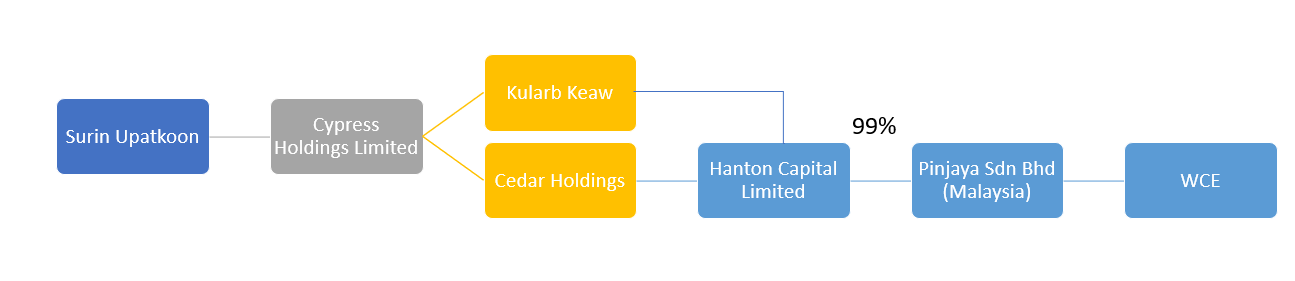
Well, as a start his original stake in WCE is through several organizations i.e. a complex holding via 5 companies namely, Cypress Holdings Limited, Pinjaya Sdn Bhd (Malaysia), Hanton Capital Limited, Cedar Holdings Limited, Kularb Kaew Company Limited
The shareholding was as depicted below:
With the exercise, it seems that the shareholding is now cleaner i.e. as below:
As in the announcement, Hanton Capital, a company resided in a tax haven, Virgin Islands has sold its 99.9% stake of Pinjaya directly to Tan Sri Surin Upatkoon.
Well, I prefer this as it is cleaner and the actual shareholder is now back into Malaysia.
What makes it change then, as sometimes business people would prefer a more complex structure.
That could be due to several reasons:
Well, as a start his original stake in WCE is through several organizations i.e. a complex holding via 5 companies namely, Cypress Holdings Limited, Pinjaya Sdn Bhd (Malaysia), Hanton Capital Limited, Cedar Holdings Limited, Kularb Kaew Company Limited
The shareholding was as depicted below:
With the exercise, it seems that the shareholding is now cleaner i.e. as below:
As in the announcement, Hanton Capital, a company resided in a tax haven, Virgin Islands has sold its 99.9% stake of Pinjaya directly to Tan Sri Surin Upatkoon.
Well, I prefer this as it is cleaner and the actual shareholder is now back into Malaysia.
What makes it change then, as sometimes business people would prefer a more complex structure.
That could be due to several reasons:
- He just want a cleaner structure (surprisingly)
- Because of the rights issue, he may use bank financing to fund part of his subscription. Banks usually prefer a cleaner structure especially when they are the one financing the purchase.
- If one is to notice above, the holding is brought back to Malaysia. As toll business has gone riskier due to the threat of government's plan of toll elimination, I believe foreign financiers are more reluctant to finance it. The financing may be dependent on local banks and they do not want to be seen financing a company with complex web of structure.
If Surin relinquishing his holdings in WCE? I think not at all, especially when he privatised MWE partly because of this.
Is there an impact on WCE? Minimal. But I prefer this structure better.
Saturday, October 26, 2019
Why the fundamentals for WCE does not change much
When I bought this share 6 years ago, I was looking really long term. Today, that mindset does not change. Sure enough, today the project faces some blip - not entirely due to the current government as they have promised the elimination of toll but also because there was a dispute over the alignment prior to that. Now, let us review what actually had happened and probably I will go through the bad news first.
Early delays
The alignment for Phase 7 had been changed as earlier the concessionaire faced a dispute from the government then on the alignment. Since then, it has been solved (after the change of government). This has caused delay in that phase and since it is a 50 + 10 year concession, the affect does not change much. Probably the biggest change was the cost of land acquisition has increased.
Threat over toll elimination by current government
I have written a piece on this after the change of government on May 9. So far, what is negative since then for WCE is that they have yet to collect toll despite completion certain sections. What was sort of promised by the government i.e. to eliminate tolls and force it onto the concessionaires i.e PLUS, Gamuda etc. did not happen. In fact, Gamuda's concessions is being bought at a fair price. In the event WCE is being forced to sell, they would be selling at a fair price as well.
Anyway, as we can see the government may not have the funds to purchase many of the concessions. Hence, it is possible the government is using Khazanah to purchase them. My question is this, if the idea of the current government is to privatise businesses, then this action acts on the opposite. Khazanah buying the concessions, would also mean they are collecting toll as well. Anyway, in the event Khazanah is buying, I think it is a a fair price of the concession, hence much higher value than what is being traded at - for WCE.
PLUS is being reviewed i.e. reduced toll rates
As in the Budget 2020, the government has promised that the toll rates for PLUS is reduced at least 18%. Well, it shows how profitable PLUS is. Despite not increasing the toll rates every 5 years, it can now afford to reduce the rates. Given the situation, I am not sure who will get (to purchase) the concessions, but surely we as EPF contributor is affected by the reduced rates collection.
The affect to WCE is probably minimal as I do not think over a long distance (from Shah Alam to Penang) driving the drivers would bother over few ringgit savings.
Increased value in land purchase
To me, this is the biggest negative, as it affects the pocket directly. Anyway, as mentioned in the prospectus, the land purchase deals 95% of them have been completed. What is done is done. WCE is disputing some of the acquisitions in court and it seems to be able to win a portion of it.
The increase in equity injection would affect the calculation of IRR in the project - assuming it is decently profitable around 10%. Any increase in equity would change the IRR and if we can remember the project has a IRR hurdle where in the event the concession's profits exceeds certain threshold, it is supposed to share a higher portion of the profits with government.
In the long run, hence the additional injection would not change much fundamentally given the IRR scenario.
Partial completion of the highway
This is the good part. It shows that the project is on the way and WCE is able to complete it. There is no reason to not believe they are capable of constructing despite the small situation over at Phase 4.
This project which has been talked about for so long is now really moving. The biggest beneficiary is Perak especially Lumut and I am sure many are waiting for the completion.
It is a long term project
Again, whatever the share price changed in the short term, there is little impact. At the moment, WCE has yet to collect toll so the financials that we see on quarterly and annually basis is no relevance. The biggest relevance is the costs and progress of construction.
Losses in the first few years
I have been asked on this, and would like to clarify. Profit and losses is not the main basis for calculation, as it is accounting (little bit deep to write in this article). What is important after the project is the cashflow. As an example, PLUS today on paper is making losses and I have read the Minister in past gladly presented the loss making fact (this loss actually is good for PLUS owners given the tax planning situation).
Let me put this in perspective, if it is making losses, why are there so many wanted to offer the purchase of PLUS?
Post 2038
There is potentially one big factor when PLUS is taken out of the tolls collection. Although PLUS is a parallel highway to WCE, there are various trends which is positive for WCE. One of them Pulau Indah port. WCE is closer to Pulau Indah, and the government is developing those areas. It is encouraging the expansion of the ports or even a new one. By then, given the development, WCE will have its own additional strength. As mentioned in past by the management, WCE's strength is its flat terrain which is a bonus for heavy vehicles.
I believe the traffic is so heavy by 2038 that, PLUS will be quite badly congested that we would have needed an alternative highway anyway. Hence WCE. I have also seen the maintenance of a non-tolled highway in Malaysia - which is not a good sight.
Early delays
The alignment for Phase 7 had been changed as earlier the concessionaire faced a dispute from the government then on the alignment. Since then, it has been solved (after the change of government). This has caused delay in that phase and since it is a 50 + 10 year concession, the affect does not change much. Probably the biggest change was the cost of land acquisition has increased.
Threat over toll elimination by current government
I have written a piece on this after the change of government on May 9. So far, what is negative since then for WCE is that they have yet to collect toll despite completion certain sections. What was sort of promised by the government i.e. to eliminate tolls and force it onto the concessionaires i.e PLUS, Gamuda etc. did not happen. In fact, Gamuda's concessions is being bought at a fair price. In the event WCE is being forced to sell, they would be selling at a fair price as well.
Anyway, as we can see the government may not have the funds to purchase many of the concessions. Hence, it is possible the government is using Khazanah to purchase them. My question is this, if the idea of the current government is to privatise businesses, then this action acts on the opposite. Khazanah buying the concessions, would also mean they are collecting toll as well. Anyway, in the event Khazanah is buying, I think it is a a fair price of the concession, hence much higher value than what is being traded at - for WCE.
PLUS is being reviewed i.e. reduced toll rates
As in the Budget 2020, the government has promised that the toll rates for PLUS is reduced at least 18%. Well, it shows how profitable PLUS is. Despite not increasing the toll rates every 5 years, it can now afford to reduce the rates. Given the situation, I am not sure who will get (to purchase) the concessions, but surely we as EPF contributor is affected by the reduced rates collection.
The affect to WCE is probably minimal as I do not think over a long distance (from Shah Alam to Penang) driving the drivers would bother over few ringgit savings.
Increased value in land purchase
To me, this is the biggest negative, as it affects the pocket directly. Anyway, as mentioned in the prospectus, the land purchase deals 95% of them have been completed. What is done is done. WCE is disputing some of the acquisitions in court and it seems to be able to win a portion of it.
The increase in equity injection would affect the calculation of IRR in the project - assuming it is decently profitable around 10%. Any increase in equity would change the IRR and if we can remember the project has a IRR hurdle where in the event the concession's profits exceeds certain threshold, it is supposed to share a higher portion of the profits with government.
In the long run, hence the additional injection would not change much fundamentally given the IRR scenario.
Partial completion of the highway
This is the good part. It shows that the project is on the way and WCE is able to complete it. There is no reason to not believe they are capable of constructing despite the small situation over at Phase 4.
This project which has been talked about for so long is now really moving. The biggest beneficiary is Perak especially Lumut and I am sure many are waiting for the completion.
It is a long term project
Again, whatever the share price changed in the short term, there is little impact. At the moment, WCE has yet to collect toll so the financials that we see on quarterly and annually basis is no relevance. The biggest relevance is the costs and progress of construction.
Losses in the first few years
I have been asked on this, and would like to clarify. Profit and losses is not the main basis for calculation, as it is accounting (little bit deep to write in this article). What is important after the project is the cashflow. As an example, PLUS today on paper is making losses and I have read the Minister in past gladly presented the loss making fact (this loss actually is good for PLUS owners given the tax planning situation).
Let me put this in perspective, if it is making losses, why are there so many wanted to offer the purchase of PLUS?
Post 2038
There is potentially one big factor when PLUS is taken out of the tolls collection. Although PLUS is a parallel highway to WCE, there are various trends which is positive for WCE. One of them Pulau Indah port. WCE is closer to Pulau Indah, and the government is developing those areas. It is encouraging the expansion of the ports or even a new one. By then, given the development, WCE will have its own additional strength. As mentioned in past by the management, WCE's strength is its flat terrain which is a bonus for heavy vehicles.
I believe the traffic is so heavy by 2038 that, PLUS will be quite badly congested that we would have needed an alternative highway anyway. Hence WCE. I have also seen the maintenance of a non-tolled highway in Malaysia - which is not a good sight.
Thursday, July 19, 2018
Buying more WCE
I have decided to purchase some 13,200 units of WCEHB. In the process, I have sold 5,700 units of Power Root for the fund.
I have held the stock, WCE for a long time since 2014 and this drop largely to do with fear of termination of most tolled highways in Malaysia, I think is overdone. There is no denying that any government of the day can do whatever they like - or could they?
More than 50% of tolled highway assets are owned by government linked organizations such as EPF, PNB, Khazanah. Those examples are PLUS Expressway, AKLEH, LKSA, SILK and several more under Prolintas. Many investors do not differentiate the difference between government linked and government. These highways are not owned by government but by the people. Best example is PLUS which is 51% owned through Khazanah and 49% by EPF. The government does not hold ownership of EPF but run the organization on the people's behalf.
By terminating PLUS without fair compensation towards EPF especially will be bad for the governance and future investment profile of the country.
WCE Sdn Bhd is indirectly semi-private and public, as I call it. 20% of the highway is owned by IJM direct, and the largest shareholder for IJM is EPF (yet again). Although it is professionally run by a set of managers, its 2nd and 3rd largest shareholders are Amanah Saham Bumiputera and Tabung Haji respectively. Besides that IJM also holds 26% of WCE Holdings, the listed company which I am buying.
In the event the government is exercising its pitch of eliminating toll highways, it will hugely impact the stock market - and not just tolled highway stocks.
At the price of RM0.75, I think the market is already putting the company on the huge assumption that the highway will not continue. Todate, WCE is 51% completed and it seems that they are continuing with the project without stopping.
On the other hand, as it seems MWE - the other 26% shareholder is picking up its shares of the additional funds - through rights - that is to be raised for the company in the next few months. If the project is affected, usually no one will inject more money. MWE is actually going private which means its company's largest shareholder is now having a larger effective stake of WCEHB.
On the merit of the highway, I do not think there is much change. The government could hold back on price toll increases in the long run which may affect WCE. I still think at RM750 million valuation, it is compensated for whatever that may be negative.
I have held the stock, WCE for a long time since 2014 and this drop largely to do with fear of termination of most tolled highways in Malaysia, I think is overdone. There is no denying that any government of the day can do whatever they like - or could they?
More than 50% of tolled highway assets are owned by government linked organizations such as EPF, PNB, Khazanah. Those examples are PLUS Expressway, AKLEH, LKSA, SILK and several more under Prolintas. Many investors do not differentiate the difference between government linked and government. These highways are not owned by government but by the people. Best example is PLUS which is 51% owned through Khazanah and 49% by EPF. The government does not hold ownership of EPF but run the organization on the people's behalf.
By terminating PLUS without fair compensation towards EPF especially will be bad for the governance and future investment profile of the country.
WCE Sdn Bhd is indirectly semi-private and public, as I call it. 20% of the highway is owned by IJM direct, and the largest shareholder for IJM is EPF (yet again). Although it is professionally run by a set of managers, its 2nd and 3rd largest shareholders are Amanah Saham Bumiputera and Tabung Haji respectively. Besides that IJM also holds 26% of WCE Holdings, the listed company which I am buying.
In the event the government is exercising its pitch of eliminating toll highways, it will hugely impact the stock market - and not just tolled highway stocks.
At the price of RM0.75, I think the market is already putting the company on the huge assumption that the highway will not continue. Todate, WCE is 51% completed and it seems that they are continuing with the project without stopping.
On the other hand, as it seems MWE - the other 26% shareholder is picking up its shares of the additional funds - through rights - that is to be raised for the company in the next few months. If the project is affected, usually no one will inject more money. MWE is actually going private which means its company's largest shareholder is now having a larger effective stake of WCEHB.
On the merit of the highway, I do not think there is much change. The government could hold back on price toll increases in the long run which may affect WCE. I still think at RM750 million valuation, it is compensated for whatever that may be negative.
Monday, May 28, 2018
The Edge: Dr Mahathir on toll concessionaires
The most recent Edge Weekly is quite a meaningful edition as it had the opportunity to interview Tun Dr Mahathir i.e. the first to do so in a private setting after GE14 where Pakatan Harapan had won the election.
I managed to get a copy during the weekend, and Dr Mahathir was enquired about his views on toll abolishment in stages as in the Pakatan Harapan's manifesto. Here are some of it (but please go and buy a copy as there are much more to read especially on ECRL, HSR etc).
TheEdge: The national debt is already so high. The government has zero-rates GST, reintroduced petrol subsidy and is reviewing toll charges. These will cost the government money. How is it going to handle the situation?
Tun Dr Mahathir: Much of the work being done now is to downsize the financing of the government. By doing away with all these expensive projects, we are already reducing (debt) servicing costs.
.....
I must admit that when we were campaigning, we proposed things so that the people would want us to be the government. But, of course, we have to manage these promises. For example, the toll review is not going to be immediate, it will be in a gradual manner.
Is the government going to acquire all the toll concessionaires?
Some we have already acquired. But we have to work with the private sector. I have read some of the proposals; they sound quite reasonable. You see, the main point is we don't want to punish the people (toll operators). At the same time, we have to ensure the government has some money to build roads.
Based on the above, it is unknown what he meant by "Some of the toll we have already acquired." Could he have meant that PLUS was for example is already 51% owned by Khazanah, the only government owned that I know which is owned by the government. Many other toll businesses are either owned through PNB (a government managed fund), EPF or some of them the shares are passively owned by Malaysian funds.
Toll business which traditionally have been the safer bet assets, have been hammered especially when several individuals have appeared to justify that they will follow the Pakatan Harapan's manifesto of abolishing toll in stages. From there, the toll concession shares have suffered drastic drop and some of them have been owned by my investment fund. These are WCE, Ekovest, LITRAK, MRCB.
What was initially feared is that the government will be using a clause which is available in the toll contract i.e. in the "expropriation clause" where the government can acquire them for national, public interest or public security.
Of course, the argument from many (including me) is that in doing so, it will collapse the capital and bonds market where toll concessionaire's bonds are among the highest in total.
What I think may happen?
As mentioned by EPF's CEO, the toll business acquisition has to be looked at holistically. In my mind, holistically means it has to be looked at in its entirety and it may involve Khazanah, PNB and EPF in acquiring these assets. The bonds may also be repackaged and new shares may also be offered in the capital market.
One may ask: But, it does not eliminate toll charges. Yes, but in reducing the toll charges, it is already a win. When the government together with the funds are able to negotiate a package with the toll owners, they can relook at an optimum charge towards the users as well as a decent return for the investors i.e. the funds.
It has to be understood, rightly so, some of these toll businesses have made quite a lot throughout the concession period. Among them are LITRAK and PLUS and these have been the topic of contention among the politicians like Tony Pua.
Hence, by acquiring the concessions outright at a fair price and repackage the toll rates, they may seem to be the best option.
Sunday, May 13, 2018
My thoughts on WCE after the GE14
I am sure many people would be concerned and confused on what to do with WCE which is a toll concession business after the Pakatan Harapan (PH) has won the election. Among the manifesto, PH has proposed for a staged elimination of toll concessions in Malaysia. They are also proposing for renegotiation of the highway concession contracts.
I have seen several press articles as well as a video put up by Tony Pua.
Well, while some of the toll concession businesses has made tonnes of profits (such as LDP, Maju, PLUS), the way it is presented (by Tony) is somewhat misleading. One cannot just say that because of the concessionaire has invested a "y" amount of money and they have profited several times more from the y investment, then the concession should be bought back at cost +.
In finance, where especially projects are concerned, one of most important theory is "Time Value of Money". I do not want to explain so much on that concept, but here is a good explanation. From that explanation, usually for a project to kickstart especially concession business such as the toll, the concession owner will invest upfront for a number of years (in the case of WCE - more than 5 years), and upon the completion, they will start collecting from the tolling proceeds.
Note that finance is different from accounting. Finance has element of time while accounting does not take into account time. In this case, finance is more relevant.
As in any business, the biggest question is who will be coming up with that big sum of money (including cash and borrowings) and ultimately allowing the government to buyback the projects at cost or even cost plus? Nobody.
It is illogical. Nobody wants to take up that risk that way. It defeats entrepreneuralism.
This is because there are completion risk, borrowing risk and return risk that the business concession has to stomach. As an example again for WCE, there are not many construction companies that can complete these kind of projects. Why it has been delayed is that companies like Talam were not capable of doing it and ultimately not getting the financing and support needed. Hence, me being convinced to invest into this project is because it is a IJM led project. Even then, as one can see, there are additional risks now.
One of the biggest message that has been given by the current PH government is the application of the "rule of law". Mahathir also put huge importance onto the economy (which is why the council of elders comprising of 5 very experience people i.e. Daim, Zeti, Robert Kuok, Hassan Merican and Jomo) are all financial and economic experts. Many other countries, their advisors are mix of security, financial, legal etc. But the first team formed in Malaysia are all finance and economy.
To eliminate tolls, the older projects are those such as PLUS, LDP, and PNB owned Prolintas.
All our large funds such as EPF, PNB (ASM and ASB), KWAP, Khazanah etc. owns large proportions of these projects. Prolintas which owns 6 highways i,e, AKLEH, SUKE, LKSA, SILK, DASH, GCE is wholly owned by PNB.
EPF owns 49% of the biggest highway chain in Malaysia i.e. PLUS while the remaining 51% is owned by Khazanah. PLUS has a RM23.35 billion sukuk bond which is largely unpaid, probably not even paid principal yet. If the government wants to eliminate toll, it has to find ways to repay this i.e. more than RM23.25 billion bonds. By taking out PLUS, it will impact EPF contributors as well. And Khazanah also, which is under MOF.
As it is, there are a lot of financial issues that the government has to tackle and the main part of them are eliminating GST, continuing with BRIM, bringing back some of the subsidies. Obviously, to look at doing away with tolls, it is a very hard task and not as easy as explained by Tony Pua.
The merits of WCE itself
WCE is an important project. It not only connects the west coast where if one is to take the old Federal roads which is inconvenient, but it also connects ports such as Klang, Penang and Lumut. The road is much flatter and more friendlier to heavy vehicles. These are all the important economic development which has been promoted by many of the PH leaders, chief among them Mahathir, Daim and perhaps even Anwar.
Moreover, which part of Malaysia gave the biggest endorsement to the new government? West coast of Malaysia. I.e. connecting Taiping, Lumut, Tanjong Malim, most parts of Selangor - all which have brought the wins to PH.
In fact, I may not be surprise, the new government is better for WCE as some alignment as it is now is still not finalised, especially Tanjong Karang.
IJM is one of the most respected construction company and without them, the costs of the highway could have been even higher as they are not only capable of building the highway but they are also able to manage the costs.
One should take note that the large part of its management today is from Road Builder Bhd - which was merged into IJM back in 2005. Road Builder as in its name is particularly strong in building roads and West Coast Expressway is not one easy feat. Portions of WCE is on soft soil, which is not easy.
What may happen with the new mandate with the Manifesto
To entirely take away tolls, that is not easy. But to payoff especially the older tolls, that will show that current PH government meant what they promised. The older tolled highways are LDP, Lebuhraya Sungai Besi, first Penang Bridge etc. But even to do that it can be costly as it is not about buying back but also the costs of maintenance.
I would suggest the current PH government to declassify the contracts so that it is becoming more transparent. Speaking of the fairness of the contract, I believe the WCE contract is one of the most fair tolled highways. This is because it has fixed the IRR (actual IRR is not revealed but I hear that it is a higher single digit percentage - not double digit) and if the highway achieves that IRR, government will get a share of the profits over and above the IRR threshold.
I also believe some part of the contracts may be renegotiated. But as mentioned above, a decent IRR (I think) has already been incorporated for the WCE highway.
What about WCE's valuation?
Assuming that the current government is not illogical (by killing the project, and not paying compensation, where even then the court is the remedy for WCE) and follow the rule of law - the price of WCE where it is currently at 93 sen continues to warrant my interest. With the recent proposed fund raising, at 93 sen it will increase the market capitalisation of WCE to RM1.5 billion. This is still a good valuation for investors.
Mahathir has already said the abolishment of tolls will be done according to the contracts. And the contract mechanism for WCE I believe will have elements of protection for the shareholders. After the contract has been finalised, there were 2 major new shareholders that has gone into the business - MWE and Mamee. They would not have bought into the company if their rights are not protected in the contract.
In summary, the bigger risk after the new government is formed is whether they will follow the "rule of law" as promised and being rational in terms of financial management. Now, let's see!
I have been one of the guys whom have been rooting for a change. That was why I was not concerned with the manifesto of PH especially on tolled highways, but after their big surprise win, it made me think of the consequence of the promise.
I have seen several press articles as well as a video put up by Tony Pua.
Well, while some of the toll concession businesses has made tonnes of profits (such as LDP, Maju, PLUS), the way it is presented (by Tony) is somewhat misleading. One cannot just say that because of the concessionaire has invested a "y" amount of money and they have profited several times more from the y investment, then the concession should be bought back at cost +.
In finance, where especially projects are concerned, one of most important theory is "Time Value of Money". I do not want to explain so much on that concept, but here is a good explanation. From that explanation, usually for a project to kickstart especially concession business such as the toll, the concession owner will invest upfront for a number of years (in the case of WCE - more than 5 years), and upon the completion, they will start collecting from the tolling proceeds.
Note that finance is different from accounting. Finance has element of time while accounting does not take into account time. In this case, finance is more relevant.
As in any business, the biggest question is who will be coming up with that big sum of money (including cash and borrowings) and ultimately allowing the government to buyback the projects at cost or even cost plus? Nobody.
It is illogical. Nobody wants to take up that risk that way. It defeats entrepreneuralism.
This is because there are completion risk, borrowing risk and return risk that the business concession has to stomach. As an example again for WCE, there are not many construction companies that can complete these kind of projects. Why it has been delayed is that companies like Talam were not capable of doing it and ultimately not getting the financing and support needed. Hence, me being convinced to invest into this project is because it is a IJM led project. Even then, as one can see, there are additional risks now.
One of the biggest message that has been given by the current PH government is the application of the "rule of law". Mahathir also put huge importance onto the economy (which is why the council of elders comprising of 5 very experience people i.e. Daim, Zeti, Robert Kuok, Hassan Merican and Jomo) are all financial and economic experts. Many other countries, their advisors are mix of security, financial, legal etc. But the first team formed in Malaysia are all finance and economy.
To eliminate tolls, the older projects are those such as PLUS, LDP, and PNB owned Prolintas.
All our large funds such as EPF, PNB (ASM and ASB), KWAP, Khazanah etc. owns large proportions of these projects. Prolintas which owns 6 highways i,e, AKLEH, SUKE, LKSA, SILK, DASH, GCE is wholly owned by PNB.
EPF owns 49% of the biggest highway chain in Malaysia i.e. PLUS while the remaining 51% is owned by Khazanah. PLUS has a RM23.35 billion sukuk bond which is largely unpaid, probably not even paid principal yet. If the government wants to eliminate toll, it has to find ways to repay this i.e. more than RM23.25 billion bonds. By taking out PLUS, it will impact EPF contributors as well. And Khazanah also, which is under MOF.
As it is, there are a lot of financial issues that the government has to tackle and the main part of them are eliminating GST, continuing with BRIM, bringing back some of the subsidies. Obviously, to look at doing away with tolls, it is a very hard task and not as easy as explained by Tony Pua.
The merits of WCE itself
WCE is an important project. It not only connects the west coast where if one is to take the old Federal roads which is inconvenient, but it also connects ports such as Klang, Penang and Lumut. The road is much flatter and more friendlier to heavy vehicles. These are all the important economic development which has been promoted by many of the PH leaders, chief among them Mahathir, Daim and perhaps even Anwar.
Moreover, which part of Malaysia gave the biggest endorsement to the new government? West coast of Malaysia. I.e. connecting Taiping, Lumut, Tanjong Malim, most parts of Selangor - all which have brought the wins to PH.
In fact, I may not be surprise, the new government is better for WCE as some alignment as it is now is still not finalised, especially Tanjong Karang.
IJM is one of the most respected construction company and without them, the costs of the highway could have been even higher as they are not only capable of building the highway but they are also able to manage the costs.
One should take note that the large part of its management today is from Road Builder Bhd - which was merged into IJM back in 2005. Road Builder as in its name is particularly strong in building roads and West Coast Expressway is not one easy feat. Portions of WCE is on soft soil, which is not easy.
What may happen with the new mandate with the Manifesto
To entirely take away tolls, that is not easy. But to payoff especially the older tolls, that will show that current PH government meant what they promised. The older tolled highways are LDP, Lebuhraya Sungai Besi, first Penang Bridge etc. But even to do that it can be costly as it is not about buying back but also the costs of maintenance.
I would suggest the current PH government to declassify the contracts so that it is becoming more transparent. Speaking of the fairness of the contract, I believe the WCE contract is one of the most fair tolled highways. This is because it has fixed the IRR (actual IRR is not revealed but I hear that it is a higher single digit percentage - not double digit) and if the highway achieves that IRR, government will get a share of the profits over and above the IRR threshold.
I also believe some part of the contracts may be renegotiated. But as mentioned above, a decent IRR (I think) has already been incorporated for the WCE highway.
What about WCE's valuation?
Assuming that the current government is not illogical (by killing the project, and not paying compensation, where even then the court is the remedy for WCE) and follow the rule of law - the price of WCE where it is currently at 93 sen continues to warrant my interest. With the recent proposed fund raising, at 93 sen it will increase the market capitalisation of WCE to RM1.5 billion. This is still a good valuation for investors.
Mahathir has already said the abolishment of tolls will be done according to the contracts. And the contract mechanism for WCE I believe will have elements of protection for the shareholders. After the contract has been finalised, there were 2 major new shareholders that has gone into the business - MWE and Mamee. They would not have bought into the company if their rights are not protected in the contract.
In summary, the bigger risk after the new government is formed is whether they will follow the "rule of law" as promised and being rational in terms of financial management. Now, let's see!
I have been one of the guys whom have been rooting for a change. That was why I was not concerned with the manifesto of PH especially on tolled highways, but after their big surprise win, it made me think of the consequence of the promise.
Monday, July 31, 2017
WCE's new equity raising
I am an investor of WCE Holdings since 2014 and I hold significant portion of my assets in WCE. It is no coincidence that when its Annual Report is filed, I would take no time to go through them (especially the important portion).
This time, for 2017's Annual Report which was presented today, I noticed something new and significant which no one of us especially the minority shareholders do not know.
As some would know, West Coast Expressway has 3 forms of funding i.e. Government Support Loan, Commercial Loan and equity injection. That would be in the quantum as above i.e. RM2.4 billion (GSL), RM2.5 billion (commercial loan) and RM1.2 billion (equity).
While WCE has managed to secure the loans from the government earlier on in 2014 and all the debt financing by 2015, one of the component which it was supposed to raise is the equity portion.
It is also to be noted that the Redeemable Unsecured Murabahah Loan Stocks (RUMS) is issued for RM990 million and it appears that the profit rate is 10% - quite high for my liking. This is a 40 year instrument. (If I am not wrong, it could potentially for tax reasons, it is structured this way.)
Also, would like to highlight that none of this instruments was mentioned either in the press or the AGM (which was held late August 2016) although the issuance was done on 12 Jul 2016.
Note: A reader below has highlighted that the loan stocks is issued by WCEHB to WCE Holdings. Hence, the equity issuance is still needed.
This time, for 2017's Annual Report which was presented today, I noticed something new and significant which no one of us especially the minority shareholders do not know.
As some would know, West Coast Expressway has 3 forms of funding i.e. Government Support Loan, Commercial Loan and equity injection. That would be in the quantum as above i.e. RM2.4 billion (GSL), RM2.5 billion (commercial loan) and RM1.2 billion (equity).
While WCE has managed to secure the loans from the government earlier on in 2014 and all the debt financing by 2015, one of the component which it was supposed to raise is the equity portion.
It is also to be noted that the Redeemable Unsecured Murabahah Loan Stocks (RUMS) is issued for RM990 million and it appears that the profit rate is 10% - quite high for my liking. This is a 40 year instrument. (If I am not wrong, it could potentially for tax reasons, it is structured this way.)
Also, would like to highlight that none of this instruments was mentioned either in the press or the AGM (which was held late August 2016) although the issuance was done on 12 Jul 2016.
Note: A reader below has highlighted that the loan stocks is issued by WCEHB to WCE Holdings. Hence, the equity issuance is still needed.
Thursday, April 20, 2017
DO NOT SELL WCE, Airasia and Ekovest
This is a reminder that I gave to myself. Everyone will have their own preferences according to what they are comfortable with. I am comfortable with Airasia, Ekovest and WCE. Those are obvious. In investment as what are mentioned by the top notched investors - it is difficult to find gems all the time.
To some people, they may like diamond, some may like ruby. Others may like Emerald. To me, investments is the same.
THIS DOES NOT MEAN I WILL HOLD THEM FOR LIFE.
However, I am very comfortable with what I have found. Some people may be very comfortable with Top Glove for example as they know the business. Some may be very comfortable with Inari as again they know the business and are confident of their views on the semiconductor sector.
For the 3 stocks, I discovered WCE back in 2013/14. Those people who read my blog would know I have done lots of research on the company and its business. This article is not about me saying again what I have said on the business and company as you can find them here.
Then 2015, Airasia went to ridiculous low price. Around RM1.50 was my price point of buying in. You know the fantastic thing is that I knew while oil price was dropping like from USD100 to USD50, many people were focusing on Airasia's debt which it definitely can service - they were ramping up to fight, hence the debt but those assets were already generating cashflow. Not all high debts are bad! So, while the stock price should have gone up, people were selling down - I should have thanked the Hong Kong research house. So who says Malaysians are not smart - we were buying, they were selling (or could it be talking it down to buy?) - Perhaps, they are smarter. I was perhaps the stupid guy who was telling the truth on how cheap and good Airasia was.
(You would also know I was negative on Airasia X, but not Airasia. I am right until now.) So, you may ask - how is it that businesses in almost the same space can be different although run by the same management? I can be wrong in terms of share price in the short term, but in the long run, I hope I am right.
Last year, 2016 was when I realised Ekovest is realising its asset value and having a fantastic business. They are not the best of contractors but good enough. The thing is though, again I shall say this - they have fantastic assets, which many are already realising cashflows.
Yes, of course I can make mistakes. However, you would note that in many cases of businesses that I have put positive comments - they are good businesses run by good people. Some may face the wrath of situations - such as Parkson, Aeon example. Even YFG - look at how they really try hard to revive the business!
Whenever, I write here - I do not write for purchase in the short term - hit and run. Or pump and dump. The above three stocks are testimony of that. The same goes for Padini, Power Root, Insas, Tropicana, TA, Freight Management etc.
My style is very different. You can read this article and if you believe the same as me - one does not need to read another article of mine for next 3 years. Come back when there is a major catastrophe or war in the Middle East. I am very different from many of the "sifus" out there (which I am not on par with them, because they can work wonders by buying a SCADA system company which they do not understand about - as they only look at the financial numbers.) As mentioned here, I look at business first then financials (although I am a financial person). Note, they are definitely not wrong as there are many ways to skin a cat.
BTW, that SCADA system company is a good company, just that I do not feel comfortable enough to put lots of my money into it.
I am also not the type of feeling remorse when I did not buy Inari (although I know enough of them) when it was trading at 35 sen 6 years back - this company has achieved a 10 bagger - as I was not comfortable enough - again. Why? Because it was a single customer company - Avago (today's Broadcom). Who knows how its "taiko" is going to treat them? Today, it is still largely single customer although it tries to diversify. Again, some people may know enough to be comfortable. That feeling discomfort caused me lots of potential gain, but I would have sold them long time ago anyway.
In the longer run (10-20 years), things can change. Airasia can be facing new challenges for example or it could have gone overpriced. Similar to Ekovest or even WCE. Sometimes, even in the short term, it can be particularly bad for some companies - example oil price goes through the roof for airlines business. Airasia could be facing regulatory challenges in India and Indonesia or even Vietnam.
I am always (or hope) aware of these. Again, I am not sleeping with my stocks but I am also not careless to sell them when they are growing. This is like you have prepared and provided for your 18 year kid - when is time to realise the benefit - we stop supporting them.
To some people, they may like diamond, some may like ruby. Others may like Emerald. To me, investments is the same.
THIS DOES NOT MEAN I WILL HOLD THEM FOR LIFE.
However, I am very comfortable with what I have found. Some people may be very comfortable with Top Glove for example as they know the business. Some may be very comfortable with Inari as again they know the business and are confident of their views on the semiconductor sector.
For the 3 stocks, I discovered WCE back in 2013/14. Those people who read my blog would know I have done lots of research on the company and its business. This article is not about me saying again what I have said on the business and company as you can find them here.
Then 2015, Airasia went to ridiculous low price. Around RM1.50 was my price point of buying in. You know the fantastic thing is that I knew while oil price was dropping like from USD100 to USD50, many people were focusing on Airasia's debt which it definitely can service - they were ramping up to fight, hence the debt but those assets were already generating cashflow. Not all high debts are bad! So, while the stock price should have gone up, people were selling down - I should have thanked the Hong Kong research house. So who says Malaysians are not smart - we were buying, they were selling (or could it be talking it down to buy?) - Perhaps, they are smarter. I was perhaps the stupid guy who was telling the truth on how cheap and good Airasia was.
(You would also know I was negative on Airasia X, but not Airasia. I am right until now.) So, you may ask - how is it that businesses in almost the same space can be different although run by the same management? I can be wrong in terms of share price in the short term, but in the long run, I hope I am right.
Last year, 2016 was when I realised Ekovest is realising its asset value and having a fantastic business. They are not the best of contractors but good enough. The thing is though, again I shall say this - they have fantastic assets, which many are already realising cashflows.
Yes, of course I can make mistakes. However, you would note that in many cases of businesses that I have put positive comments - they are good businesses run by good people. Some may face the wrath of situations - such as Parkson, Aeon example. Even YFG - look at how they really try hard to revive the business!
Whenever, I write here - I do not write for purchase in the short term - hit and run. Or pump and dump. The above three stocks are testimony of that. The same goes for Padini, Power Root, Insas, Tropicana, TA, Freight Management etc.
My style is very different. You can read this article and if you believe the same as me - one does not need to read another article of mine for next 3 years. Come back when there is a major catastrophe or war in the Middle East. I am very different from many of the "sifus" out there (which I am not on par with them, because they can work wonders by buying a SCADA system company which they do not understand about - as they only look at the financial numbers.) As mentioned here, I look at business first then financials (although I am a financial person). Note, they are definitely not wrong as there are many ways to skin a cat.
BTW, that SCADA system company is a good company, just that I do not feel comfortable enough to put lots of my money into it.
I am also not the type of feeling remorse when I did not buy Inari (although I know enough of them) when it was trading at 35 sen 6 years back - this company has achieved a 10 bagger - as I was not comfortable enough - again. Why? Because it was a single customer company - Avago (today's Broadcom). Who knows how its "taiko" is going to treat them? Today, it is still largely single customer although it tries to diversify. Again, some people may know enough to be comfortable. That feeling discomfort caused me lots of potential gain, but I would have sold them long time ago anyway.
In the longer run (10-20 years), things can change. Airasia can be facing new challenges for example or it could have gone overpriced. Similar to Ekovest or even WCE. Sometimes, even in the short term, it can be particularly bad for some companies - example oil price goes through the roof for airlines business. Airasia could be facing regulatory challenges in India and Indonesia or even Vietnam.
I am always (or hope) aware of these. Again, I am not sleeping with my stocks but I am also not careless to sell them when they are growing. This is like you have prepared and provided for your 18 year kid - when is time to realise the benefit - we stop supporting them.
Wednesday, February 22, 2017
Why I still keep my portfolio
I noticed that there are quite a lot of views on the portfolio that I keep and I thought that I owe some of the people what I do think of it - where after a long while I have not been talking about it.
Right now, the stocks that I hold through the Felice's Fund is as below:
Alternatively, you can also view them here.
One would have noticed, I seldom buy and sell as compared to some other bloggers - some of them I have been critical of. Why? Firstly, if I am to share my portfolio or how I deal with my investment, I always believe that I have to be responsible. If I trade them often, then it is unfair towards the readers. I am not stupid to see that some people do take notice and tend to have a followers mentality (although the decision to invest is ultimately the readers themselves) and just emulate.
You would notice that over the last 2 -3 years some of those stocks that I have bought, would have moved lower than my purchase price during certain times. These happened to stocks like EcoWorld, Ekovest-WB, WCE, Insas. In fact, some of these stocks are still trading below my purchase price - e.g. Tropicana and TA.
(Hence, the moral of the above paragraph is not to follow me as the stock I pick does not tend to have immediate upside. You can in fact wait.)
Those whom have read my articles, would know that in the stocks I picked, I tend to be more careful and have deep thoughts and research over them. In fact, the stocks I picked here in my blog, I am even more careful as opposed to my other personal investment account - where I tend to be more aggressive. In times where stock market is on the uptrend, generally being aggressive would bring more upside. But over the last 50 days where market have been more active, I have not even shown a single trade in my portfolio.
Why?
First of all, I am still very happy with the portfolio that I have. There could be some readjustment...for example, I could have bought more Ekovest and TA - but generally these are just as good.
You would also know that my investment horizon is over many many years to an extent that I have penned down it is a 2027 target. Basically, this means very long term investment. For those whom do not have that kind of horizon, please do not try to emulate.
Why again WCE
As an example again, WCE - one will not see good positive numbers until few years down the road. The only number I tend to follow is how much its development expenditure has gone up to. Through that, it gave me an indication that the project is progressing - although not the best indicator. Besides that, I also see its borrowings level. These numbers will not tell me whether the company is able to keep the construction within budget - but to me as long as it is within certain range, it is good enough for me.
WCE definitely is not a "sure thing" stock, but I have certain confidence that I think it has a good probability to succeed well. My margin of safety is the upside is huge while the downside is lower. Just to give an example (which sometimes I have mentioned before but did not elaborate).
WCE is a holding company. It holds 2 main companies - WCE, the highway which it owns 80% and Rimbayu which it owns 40%. We know that Rimbayu is quite safe as it has land and these projects are now selling albeit slower due to the slowdown in property sector - but it will get there. Whether the project is 15 years or 20 years, there are limited downside in my opinion. But the upside is not that much - perhaps slightly more than RM1 billion in total?
As for WCE, the highway subsidiary, currently the company is raising hundreds of millions to pump into the project. People who invest mostly would know that the holding company is ring-fenced against its subsidiary's bad performance. Assuming (which I do not think so), WCE the highway is so bad that it does not perform at all - something like the Seremban - PD highway. Then WCE Holding's return from WCE highway is zero. It will not be negative as they are different entities and one should note that some of the bonds are guaranteed by Danajamin. Even if WCE Expressway needs more funds injections, there are ways to get around it without affecting WCE Holdings that negatively.
On the other hand, its performance on the upside is tremendous even with say 8% IRR. I will not show you the cashflow but people in finance will be able to figure it out. Or else, just think of it this way after the completion (with an IRR of 8%), the compounding would be just crazy over 50 years. This is why I take note of the progress of the project.
What about others?
Again, most of the stocks I hold are for long term. These applies to Ekovest - which has similar trait to WCE but with more immediate return. The structure is quite different. With WCE, it is more direct, which is why I hold WCE more as well.
I do not have to put much mention on Airasia. The more I say, there are certain groups which would say I try to move the stock - but if you look at its daily volume, you would know that no 1 single individual can do anything to Airasia's stock performance. At this moment, I can say is that I admit the structure is not simple (and that is admitted by Tony Fernandes). The devil is in the detail, and once it gets simpler, many things would be clearer. Another thing is that the group does do things. They talk a lot and they do a lot as well. Some companies do a lot of talking but do not do. Airasia REALLY sells tickets.
As for DKSH, well to me it is one of the cheapest consumer stock which can have large upside. To me, DKSH has yet to perform to its ability - which is why it is my longest holding stock i.e. since I started this portfolio.
What about Ecoworld? Just purely a fantastic property company. Anyone who is in the premium property business would have wished that PNB did not do a big controlling purchase of SP Setia - because it created a bigger monster. And ironically, it competes BIG against SP Setia as well.
Insas? Inari is real and through that alone Insas is certainly cheap, just that one would wish that the controlling shareholders provide a fair deal towards its shareholders. There is a tendency for the controlling guys to do an ICap which is not fair. The only thing I can say is if one gets older - there is a higher chance they get more sensible. Insas controlling shareholders are not getting younger.
TA? Quite similar to Insas but (don't know why) I am more confident towards the attitude of the TA's shareholders. For one thing, in the past (many many years ago), TA was a darling, hot stock. Today TA is no longer that and the controlling shareholders I hope does not have that mentality. It is just that - it is true, TA did not perform well financially in the past few years and many people just does not understand its financials which can be more complex. In this case, I hope time is my friend.
Tropicana? Wow, like I have said before Tropicana has changed in its business strategy and not many people understand that. It no longer holds single individual properties all over the place but holds huge development land in attractive places. It is not Ecoworld for sure, but do go over to have a look at Tropicana's projects and you would realise that it is not a RM1.4 billion property company.
Right now, the stocks that I hold through the Felice's Fund is as below:
Alternatively, you can also view them here.
One would have noticed, I seldom buy and sell as compared to some other bloggers - some of them I have been critical of. Why? Firstly, if I am to share my portfolio or how I deal with my investment, I always believe that I have to be responsible. If I trade them often, then it is unfair towards the readers. I am not stupid to see that some people do take notice and tend to have a followers mentality (although the decision to invest is ultimately the readers themselves) and just emulate.
You would notice that over the last 2 -3 years some of those stocks that I have bought, would have moved lower than my purchase price during certain times. These happened to stocks like EcoWorld, Ekovest-WB, WCE, Insas. In fact, some of these stocks are still trading below my purchase price - e.g. Tropicana and TA.
(Hence, the moral of the above paragraph is not to follow me as the stock I pick does not tend to have immediate upside. You can in fact wait.)
Those whom have read my articles, would know that in the stocks I picked, I tend to be more careful and have deep thoughts and research over them. In fact, the stocks I picked here in my blog, I am even more careful as opposed to my other personal investment account - where I tend to be more aggressive. In times where stock market is on the uptrend, generally being aggressive would bring more upside. But over the last 50 days where market have been more active, I have not even shown a single trade in my portfolio.
Why?
First of all, I am still very happy with the portfolio that I have. There could be some readjustment...for example, I could have bought more Ekovest and TA - but generally these are just as good.
You would also know that my investment horizon is over many many years to an extent that I have penned down it is a 2027 target. Basically, this means very long term investment. For those whom do not have that kind of horizon, please do not try to emulate.
Why again WCE
As an example again, WCE - one will not see good positive numbers until few years down the road. The only number I tend to follow is how much its development expenditure has gone up to. Through that, it gave me an indication that the project is progressing - although not the best indicator. Besides that, I also see its borrowings level. These numbers will not tell me whether the company is able to keep the construction within budget - but to me as long as it is within certain range, it is good enough for me.
WCE definitely is not a "sure thing" stock, but I have certain confidence that I think it has a good probability to succeed well. My margin of safety is the upside is huge while the downside is lower. Just to give an example (which sometimes I have mentioned before but did not elaborate).
WCE is a holding company. It holds 2 main companies - WCE, the highway which it owns 80% and Rimbayu which it owns 40%. We know that Rimbayu is quite safe as it has land and these projects are now selling albeit slower due to the slowdown in property sector - but it will get there. Whether the project is 15 years or 20 years, there are limited downside in my opinion. But the upside is not that much - perhaps slightly more than RM1 billion in total?
As for WCE, the highway subsidiary, currently the company is raising hundreds of millions to pump into the project. People who invest mostly would know that the holding company is ring-fenced against its subsidiary's bad performance. Assuming (which I do not think so), WCE the highway is so bad that it does not perform at all - something like the Seremban - PD highway. Then WCE Holding's return from WCE highway is zero. It will not be negative as they are different entities and one should note that some of the bonds are guaranteed by Danajamin. Even if WCE Expressway needs more funds injections, there are ways to get around it without affecting WCE Holdings that negatively.
On the other hand, its performance on the upside is tremendous even with say 8% IRR. I will not show you the cashflow but people in finance will be able to figure it out. Or else, just think of it this way after the completion (with an IRR of 8%), the compounding would be just crazy over 50 years. This is why I take note of the progress of the project.
What about others?
Again, most of the stocks I hold are for long term. These applies to Ekovest - which has similar trait to WCE but with more immediate return. The structure is quite different. With WCE, it is more direct, which is why I hold WCE more as well.
I do not have to put much mention on Airasia. The more I say, there are certain groups which would say I try to move the stock - but if you look at its daily volume, you would know that no 1 single individual can do anything to Airasia's stock performance. At this moment, I can say is that I admit the structure is not simple (and that is admitted by Tony Fernandes). The devil is in the detail, and once it gets simpler, many things would be clearer. Another thing is that the group does do things. They talk a lot and they do a lot as well. Some companies do a lot of talking but do not do. Airasia REALLY sells tickets.
As for DKSH, well to me it is one of the cheapest consumer stock which can have large upside. To me, DKSH has yet to perform to its ability - which is why it is my longest holding stock i.e. since I started this portfolio.
What about Ecoworld? Just purely a fantastic property company. Anyone who is in the premium property business would have wished that PNB did not do a big controlling purchase of SP Setia - because it created a bigger monster. And ironically, it competes BIG against SP Setia as well.
Insas? Inari is real and through that alone Insas is certainly cheap, just that one would wish that the controlling shareholders provide a fair deal towards its shareholders. There is a tendency for the controlling guys to do an ICap which is not fair. The only thing I can say is if one gets older - there is a higher chance they get more sensible. Insas controlling shareholders are not getting younger.
TA? Quite similar to Insas but (don't know why) I am more confident towards the attitude of the TA's shareholders. For one thing, in the past (many many years ago), TA was a darling, hot stock. Today TA is no longer that and the controlling shareholders I hope does not have that mentality. It is just that - it is true, TA did not perform well financially in the past few years and many people just does not understand its financials which can be more complex. In this case, I hope time is my friend.
Tropicana? Wow, like I have said before Tropicana has changed in its business strategy and not many people understand that. It no longer holds single individual properties all over the place but holds huge development land in attractive places. It is not Ecoworld for sure, but do go over to have a look at Tropicana's projects and you would realise that it is not a RM1.4 billion property company.
Saturday, February 11, 2017
WCE: Raising funds at the right price
Having idled for more than 2 years, WCE has just experienced a good climb from RM0.90 beginning of the year to RM1.27 in just over a period of 40 days as it is possibly getting ready to raise further funding. We know that to complete the expressway and due to the condition from its funding, it will need to make up its equity portion to RM1.2 billion. Since WCE Holding owns 80% of West Coast Expressway, that comes to it needing RM960 million.
From its earlier funding, profit from construction and properties (Rimbayu) and sale of several assets, it probably has managed to gather around RM700 million. If that is the case, WCE will still need around RM200 - RM250 million depending on the performance of the company over the next 2 years.
The biggest question is how it is going to do the fund raising and at what price. Looking back at what WCE had done over the last 6 years in its preparation for the project, it has done 3 rounds of fund raising. The first one a private placement pricing its shares at RM1.22 back in 2011 (see below).
Ironically, when the project was confirmed, it did another round of private placement - this time at a price of RM1.11 in 2013 (see below).
Then, one year after that it did a rights issue pricing the stocks at RM1.08 in 2014. (One could argue that it was a rights issue and every shareholder has the right to participate)
What is ironic from above is that the closer it has gotten to the fruition of the project, the price it did its fund raising just went lower and lower.
Now that it is possibly doing another round in the near term, question is will it wrongly price its new shares offering, hence diluting further the current shareholders unfairly? One should note that one of its major shareholders, MWE bought a 22% chunk from Tan Sri Chan Ah Chye at RM1.35.
Because of the continuous under-pricing of its transactions, it would be really weird if another round of funding is done at below RM1.35 - wouldn't it be? And this is yet to take into account that the project is getting closer to completion (2 years time) and the holding costs of all those people whom have been subscribing to the earlier issuance.
Who seriously in their right mind, among the current set of major shareholders would agree to a low pricing?
From its earlier funding, profit from construction and properties (Rimbayu) and sale of several assets, it probably has managed to gather around RM700 million. If that is the case, WCE will still need around RM200 - RM250 million depending on the performance of the company over the next 2 years.
The biggest question is how it is going to do the fund raising and at what price. Looking back at what WCE had done over the last 6 years in its preparation for the project, it has done 3 rounds of fund raising. The first one a private placement pricing its shares at RM1.22 back in 2011 (see below).
Ironically, when the project was confirmed, it did another round of private placement - this time at a price of RM1.11 in 2013 (see below).
Then, one year after that it did a rights issue pricing the stocks at RM1.08 in 2014. (One could argue that it was a rights issue and every shareholder has the right to participate)
What is ironic from above is that the closer it has gotten to the fruition of the project, the price it did its fund raising just went lower and lower.
Now that it is possibly doing another round in the near term, question is will it wrongly price its new shares offering, hence diluting further the current shareholders unfairly? One should note that one of its major shareholders, MWE bought a 22% chunk from Tan Sri Chan Ah Chye at RM1.35.
Because of the continuous under-pricing of its transactions, it would be really weird if another round of funding is done at below RM1.35 - wouldn't it be? And this is yet to take into account that the project is getting closer to completion (2 years time) and the holding costs of all those people whom have been subscribing to the earlier issuance.
Who seriously in their right mind, among the current set of major shareholders would agree to a low pricing?
Saturday, January 21, 2017
MWE's huge misrepresentations. Does it impact WCE?
I remember I wrote about MWE a year ago. For a company who would have an earlier valuation of its land at RM31 million and later to have the same land valued at RM155 million (5x multiple) on the same year, this is really serious. I did not know SC and Bursa can still allow this to happen although they have helped smaller shareholders to get MWE to ask for an alternative valuation.
In this episode, imagine your controlling and largest shareholder signed a deal to sell the land for RM55 million thinking that market value is RM31 million. And several months later another probably a more well known property valuer gave an entirely different view, i.e. the land is actually RM155 million. Is this because the management erred or is it really something else? Can we now trust valuer?
This is an article which appeared on The Edge Weekly 2 weeks ago where they published it online.
I would like to remind that the same MWE is a substantial (2nd largest) shareholder of WCE. If not because IJM is there, I would have had serious second thought on buying the company.
Another thing I would like to highlight is that the party MWE partners with is Pristine Primavera, a subsidiary of Newfields Group of Companies (a company which is related to Seow Lun Hoo).
Ironically, Newfields is one of the party which advised on the rights issue for WCE (formerly Keuro) - see below. Even if SC is to approve, there seems like a conflict of interest as Newfields advised on the dealings of WCE where MWE is a major shareholder, and later for Newfields to do a huge business deal with MWE.
Another very fishy deal involving MWE happened 13 months ago. Tan Sri Surin Upatkoon proposed to do a privatisation of MWE at RM1.70, only for him to do a U-turn a month later. See below. This is almost like playing around with shareholders and he does not care at all.
On another related matter, remember Mamee's shareholders who are the 3rd largest shareholder in WCE - see who advised them for the group's delisting back in 2011/2012. They are all potentially inter-related.
In these episodes, there are 2 things I would like to call: really questioning the 2 professional companies Cheston Internaional KL Sdn Bhd (the valuer for the land in PJ and Newfields Advisors Sdn Bhd, the advisor for the WCE, Mamee)
In this episode, imagine your controlling and largest shareholder signed a deal to sell the land for RM55 million thinking that market value is RM31 million. And several months later another probably a more well known property valuer gave an entirely different view, i.e. the land is actually RM155 million. Is this because the management erred or is it really something else? Can we now trust valuer?
This is an article which appeared on The Edge Weekly 2 weeks ago where they published it online.
I would like to remind that the same MWE is a substantial (2nd largest) shareholder of WCE. If not because IJM is there, I would have had serious second thought on buying the company.
Another thing I would like to highlight is that the party MWE partners with is Pristine Primavera, a subsidiary of Newfields Group of Companies (a company which is related to Seow Lun Hoo).
Ironically, Newfields is one of the party which advised on the rights issue for WCE (formerly Keuro) - see below. Even if SC is to approve, there seems like a conflict of interest as Newfields advised on the dealings of WCE where MWE is a major shareholder, and later for Newfields to do a huge business deal with MWE.
Another very fishy deal involving MWE happened 13 months ago. Tan Sri Surin Upatkoon proposed to do a privatisation of MWE at RM1.70, only for him to do a U-turn a month later. See below. This is almost like playing around with shareholders and he does not care at all.
On another related matter, remember Mamee's shareholders who are the 3rd largest shareholder in WCE - see who advised them for the group's delisting back in 2011/2012. They are all potentially inter-related.
In these episodes, there are 2 things I would like to call: really questioning the 2 professional companies Cheston Internaional KL Sdn Bhd (the valuer for the land in PJ and Newfields Advisors Sdn Bhd, the advisor for the WCE, Mamee)
Monday, October 24, 2016
TheStar: Part of WCE to open early
This came out in TheStar today. However, you may want to just read from below.
There are a lot of posts from me on this company i.e. from the early days of its change of hands in substantial shareholdings. Be prepared for WCE to do some fund raising - I am not gonna speculate how it is going to do it as I had the wrong theory once. If however WCE as mentioned would be collecting revenue earlier, there is a perception that some of those revenue will be equitised hence the need for fund injection could be lower than expected - which is a good thing. As below is a portion which is picked up from its 2016 Annual Report - which says a subsidiary is required to maintain a financial service ratio of at least 1.25x and debt equity ratio of not greater than 80:20 upon the toll commencement. (Keyword: upon toll commencement). Hence, it will not need to raise money as fast.
Personally, I have made losses from this stock considering my purchase at average of RM1.10 to now being traded at RM0.90. However, if you read most of my articles on this, I do expect a long term hold on this company as a hopefully decent retirement fund and part of it for my children. I am not sure I will still be around when this concession ends i.e. 2064/65 or even more (do continue to read this blog to see I am still writing). For some of you it may be grandchildren, as this is a 50 + 10 year concession! The RM0.90 is in fact a good opportunity for me to collect more as I cannot imagine a RM900 million company will be building the second longest tolled highway (and in better part of country economically) in Malaysia.
Medium term - over next 2 years, I do not expect WCE to perform well in its income statement as it only projects to make RM10 million a year from construction and the other holding that it has i.e. Bandar Rimbayu may not be doing as well due to the poor outlook for properties in the near term.
There are a lot of posts from me on this company i.e. from the early days of its change of hands in substantial shareholdings. Be prepared for WCE to do some fund raising - I am not gonna speculate how it is going to do it as I had the wrong theory once. If however WCE as mentioned would be collecting revenue earlier, there is a perception that some of those revenue will be equitised hence the need for fund injection could be lower than expected - which is a good thing. As below is a portion which is picked up from its 2016 Annual Report - which says a subsidiary is required to maintain a financial service ratio of at least 1.25x and debt equity ratio of not greater than 80:20 upon the toll commencement. (Keyword: upon toll commencement). Hence, it will not need to raise money as fast.
Personally, I have made losses from this stock considering my purchase at average of RM1.10 to now being traded at RM0.90. However, if you read most of my articles on this, I do expect a long term hold on this company as a hopefully decent retirement fund and part of it for my children. I am not sure I will still be around when this concession ends i.e. 2064/65 or even more (do continue to read this blog to see I am still writing). For some of you it may be grandchildren, as this is a 50 + 10 year concession! The RM0.90 is in fact a good opportunity for me to collect more as I cannot imagine a RM900 million company will be building the second longest tolled highway (and in better part of country economically) in Malaysia.
Medium term - over next 2 years, I do not expect WCE to perform well in its income statement as it only projects to make RM10 million a year from construction and the other holding that it has i.e. Bandar Rimbayu may not be doing as well due to the poor outlook for properties in the near term.
Thursday, March 10, 2016
Why I think Keuro may rise 35% within the next 5 months?
For the project to go smoothly, Keuro will need to raise more equity for it to meet its debt-equity requirement as imposed by the banks or financiers. It will need more equity injection as it has already resolved its debt finances. The debt financiers over time require West Coast Expressway Sdn Bhd, an 80% subsidiary of Keuro to inject RM1.2 billion as equity capital. It has raised RM4.74 billion debt from the banks. The rest of the project money will come from the equity injection. (See below)
![]() |
| How does WCE funds its project total of RM5.94b |
So far, Keuro has already injected around RM550 million into West Coast Expressway. It will need to find another RM400 million of capital to inject into the project to make up to RM960 million (20% or RM240 million will be from IJM's subsidiary, Road Builder which owns 20% of WCE).
Some portion of the money will be the from its sale of Talam Transform (RM80 million), the second may be from its warrants. Noticed that its warrant has a short term tenure of 2 years as compared to most warrants issued in Malaysia (typically 5 years).
However for people to exercise the warrants, Keuro's share price has to be above RM1.18 as its current price of RM0.90 does not attract anyone to exercise. One might just buy the parent share at around RM0.90.
As many would notice, Keuro's shares is quite tightly held. The top 30 holds around 80% of its stocks. The top 3 (IJM, MWE, Tan Sri Pang) holds more than 60%. IJM in fact is still slowly accumulating. (I do not think MWE or Tan Sri Pang will sell as their entry price is above RM1.20 unless they did a wrong analysis of their investments before this.) Besides the Top 3, there are several shareholders whom will not sell as they have been holding for many years - even before the highway was approved. I am just thinking they are holding up and wait for the project to materialise and eventually complete.
As mentioned above, for it to raise the additional capital, it may need most of the warrants to be exercised i.e. at RM1.18. For that, shares of Keuro have to be at least priced around RM1.25 for it to be attractive. Why would anybody bother if it is priced at RM1.20. If it is significantly above the exercise price and the warrants are in the money, Keuro may be able to raise RM250 million for it to meet the equity portion. In fact, to have more certainty, it has to be above RM1.30. Exercising when the shares is at RM1.25 - RM1.30 is plain dangerous especially for a tightly held stock as the stock could easily drop to below RM1.18 within days. Maybe the minority shareholders will not take that risk.
Any other ways to raise capital? Sure - another rights issue but I do not think this is the best way. Through private placement? It is possible as well, but it will be priced above RM1 as the par value of Keuro is RM1.00. In any case, both rights and private placement has to be made at RM1.00 and above. Typically, for any rights to be attractive, the share has to be traded at significantly above the rights price.
Is there a third way to raise funds? - expect it to earn some from its current existing projects - WCE and Rimbayu, but I do not think it will reach the needed sum of RM300 million. If it does and does not need the warrant to be exercised or new issuance of rights, the share would be extremely attractive fundamentally. Imagine, it brings in free cashflow of more than RM250 million over next 3 years. That happens, the share itself is a winner. In any case, I do not think the group will take that chance i.e. dependent on profits. It only owns 40% of Rimbayu and 30% of the WCE construction portion.
From all of the above, the best situation for the company is for the warrants to be all exercised, if not all more than 80%.
And when is the warrant due to be expired? 26 August 2016 (5.5 months from now). There is no provision for the warrant expiry period to be extended.
Of course the major shareholders could do the unthinkable as they would still be exercising the warrants no matter what the parent price is, but wouldn't it be a sign that tells us the stock price at current value is very attractive for them to do this unthinkable? And as minority shareholder, it is a dream come true as major shareholders are buying shares at more expensive price (RM1.18) from what we can purchase at - RM0.90. That's amazing, wouldn't it?
IJM and the shareholders have come this far and will the project be jeopardized because of fund raising (of RM250 - RM300 million), I doubt it. If it supported Scomi by converting its convertibles, IJM will be more than wanting to make sure the WCE project goes well as its portion of the project is more than RM3 billion.
Note: You will notice, seldom do I put a specific price point in a stock especially over short term (don't like that), but in this case it is more than just long term fundamentals for the stock but more of its short to medium term needs.
This was written in my Facebook before and obviously this is entirely my own opinion and I should not be blamed for any of your trading decisions. There could also be other ways where Keuro can raise funds or the banks may loosen the conditions for their capitalisation which I did not mention here. In one of the sessions (AGM or EGM, I cannot remember) though, there was question asked about its capital needs, I remember Keuro specifically mentioned of their need to increase the capital portion for WCE, and the management does not see any challenges in getting that done. Of course, they did not particularly explain how they were going to do those but the most common way for any to raise funds are as per mentioned above.
Friday, July 31, 2015
Keuro: Audited Accounts mistake
Just had a quick run through of Keuro's audited account put up today. I believe there is a mistake on the total assets for Radiant Pillar's net assets (page 64).
If the amount is actually RM1.94 billion would have been fantastic.
Tuesday, May 26, 2015
What Keuro's 4Q15 results says
The latest quarterly results for Kumpulan Europlus was just announced yesterday and here are what can be deciphered.
- The West Coast project seems to be slow although it has started.
- lower contribution from Rimbayu for the month.
- adjustment for the fair value of holdings in Talam Transform is the major factor for its losses.
West Coast project
It seems that it has started to record in revenue and there are some progress in the project, albeit slow. By looking at the Other Intangible Asset (Concession Assets are intangibles under accounting standards), one can know that the amount has increased from RM139.7 million to RM158.5 million. Additionally, it has recorded construction revenue (Diagram 2) for the quarter of RM14.8 million. As one can see, previously construction revenue was rather non-existent. I am not sure whether project has been delayed or is it normal that it registers such low revenue, as it has just only begun.
Contribution from Rimbayu
Based on its Income Statement as below, I would think that RM3.12 million was part of the share of profit from the Rimbayu's project. The other sharing being in the forms of distributable income totalling RM2.92 million in Diagram 4. Few reasons, properties has slowed down and its progress billing was also slowed in the review period. Keuro has mentioned that the project for Phase 1 has been delivered but I doubt all have been delivered during the period. Would think that it would have spilled over to subsequent quarter.
Adjustment of fair value of Talam Transform
The main reason as mentioned for the losses was that provision for impairment on investment in associate. Keuro mainly only has Talam Transform as the significant associate. As depicted below, since it has already decided to sell those shares to Tan Sri Chan Ah Chye for RM99 million, I am just wondering why it devalue the investment held for sale as I highlighted in Diagram 1 above. On the books, those are now valued at RM78.5 million although would be sold at RM99 million. Is the sale not going to be completed?
All in all, I am not too happy with the disclosure by the management of Keuro on the progress.
- The West Coast project seems to be slow although it has started.
- lower contribution from Rimbayu for the month.
- adjustment for the fair value of holdings in Talam Transform is the major factor for its losses.
West Coast project
It seems that it has started to record in revenue and there are some progress in the project, albeit slow. By looking at the Other Intangible Asset (Concession Assets are intangibles under accounting standards), one can know that the amount has increased from RM139.7 million to RM158.5 million. Additionally, it has recorded construction revenue (Diagram 2) for the quarter of RM14.8 million. As one can see, previously construction revenue was rather non-existent. I am not sure whether project has been delayed or is it normal that it registers such low revenue, as it has just only begun.
![]() |
| Diagram 1: Assets representation for 4Q15 |
![]() |
| Diagram 2 |
Contribution from Rimbayu
Based on its Income Statement as below, I would think that RM3.12 million was part of the share of profit from the Rimbayu's project. The other sharing being in the forms of distributable income totalling RM2.92 million in Diagram 4. Few reasons, properties has slowed down and its progress billing was also slowed in the review period. Keuro has mentioned that the project for Phase 1 has been delivered but I doubt all have been delivered during the period. Would think that it would have spilled over to subsequent quarter.
![]() |
| Diagram 3 |
![]() |
| Diagram 4 |
Adjustment of fair value of Talam Transform
The main reason as mentioned for the losses was that provision for impairment on investment in associate. Keuro mainly only has Talam Transform as the significant associate. As depicted below, since it has already decided to sell those shares to Tan Sri Chan Ah Chye for RM99 million, I am just wondering why it devalue the investment held for sale as I highlighted in Diagram 1 above. On the books, those are now valued at RM78.5 million although would be sold at RM99 million. Is the sale not going to be completed?
All in all, I am not too happy with the disclosure by the management of Keuro on the progress.
Wednesday, March 4, 2015
Between Insas, Keuro and TA
For those who follow or you can check out here, I do own all the three stocks - Insas, Keuro and TA Enterprise. There is one question recently, on which one does a person choose and did I buy TA and Insas because of its relative low Price/NA.
I guess if anyone choose either of these stocks or any other, it depends on ones understanding or appetite. (I do not recommend you to buy, but in many of my cases, there is a reason I buy these stocks and I usually put them down in this blog.)
Perhaps, one does not really understand why I buy many of the stocks that I picked. All three stocks have a strong margin of safety in my mind. (Have not been using this word, but perhaps the best way to describe is Graham's Margin of Safety)
Keuro - Rimbayu project I deemed to be almost valuable as in the price I paid for the entire stock, Rimbayu's value alone I see it as equivalent to Keuro which I paid for. Remember I said, WCE is a bonus and if it is successful, it is a huge bonus - enormous. I visited many times Rimbayu before I decided to buy Keuro? And yet the main jewel is not Rimbayu yet. I do not have the opportunity to visit WCE.
Insas - same thing Inari has strong value and in itself it is worth around the price I paid for Insas. And Insas has many other businesses. It has recently been purchasing, Ho Hup - I see a good angle for it to do so. And in my blog I mentioned I talked to people in Inari, and they may not know the reason for me talking to them. I also talked to people (companies) who gives projects to Inari.
TA - The foreign properties acts as a strong hedge and they could be undervalued to the books.
However, one most important trait is that they must have good growth, or if not, strong in the future. Things I can see that will make the company valuable looking forward. No point buying a business like telco (Maxis, Digi or worse still Green Packet) when I can't see growth in the future. Telco used to be a darling stock 10 - 15 years ago. Not anymore, today. (Probably only, the one telco which I see value moving forward is TimeCom. Surprise?)
In each of the stocks I picked there are something which I see valuable.
Rimbayu, WCE - good strong projects especially WCE when it is completed.
Inari - a strong business with -remember I mentioned management. But I wanted a margin of safety, which I could not get directly from Inari. Insas, as I see it today seems to be different from Insas 10 years ago. Today's Insas has a sense of direction, which is probably why they are raising funds. Insas 10 years ago, was a careful investor - no doubt good but lacked action.
TA - well, much more defensive, but they know what they are doing and they buy good properties in good locations. Basically you can see that TA is buying for the future value. Which is also why you do not see me buying a lot. It is a strong hedging stock, with decent dividends. This company listed in Bursa is quite unique as probably I cannot find a similar one (unless you buy TA Global), much more asset hedged and top up with it, is undervalued. I would say, if one is to buy gold or silver for that matter, I like TA better.
I like businesses where they go out and work for their value. Strong differentiation and value. You do not see that in both Insas and TA - but others like DKSH, Airport, NTPM, Padini (to some extent) have that.
Well, one can say I am also boring - balik-balik same stocks. There is one place where you can get daily tips and I strongly recommend, the Edgemarkets.
I guess if anyone choose either of these stocks or any other, it depends on ones understanding or appetite. (I do not recommend you to buy, but in many of my cases, there is a reason I buy these stocks and I usually put them down in this blog.)
Perhaps, one does not really understand why I buy many of the stocks that I picked. All three stocks have a strong margin of safety in my mind. (Have not been using this word, but perhaps the best way to describe is Graham's Margin of Safety)
Keuro - Rimbayu project I deemed to be almost valuable as in the price I paid for the entire stock, Rimbayu's value alone I see it as equivalent to Keuro which I paid for. Remember I said, WCE is a bonus and if it is successful, it is a huge bonus - enormous. I visited many times Rimbayu before I decided to buy Keuro? And yet the main jewel is not Rimbayu yet. I do not have the opportunity to visit WCE.
Insas - same thing Inari has strong value and in itself it is worth around the price I paid for Insas. And Insas has many other businesses. It has recently been purchasing, Ho Hup - I see a good angle for it to do so. And in my blog I mentioned I talked to people in Inari, and they may not know the reason for me talking to them. I also talked to people (companies) who gives projects to Inari.
TA - The foreign properties acts as a strong hedge and they could be undervalued to the books.
However, one most important trait is that they must have good growth, or if not, strong in the future. Things I can see that will make the company valuable looking forward. No point buying a business like telco (Maxis, Digi or worse still Green Packet) when I can't see growth in the future. Telco used to be a darling stock 10 - 15 years ago. Not anymore, today. (Probably only, the one telco which I see value moving forward is TimeCom. Surprise?)
In each of the stocks I picked there are something which I see valuable.
Rimbayu, WCE - good strong projects especially WCE when it is completed.
Inari - a strong business with -remember I mentioned management. But I wanted a margin of safety, which I could not get directly from Inari. Insas, as I see it today seems to be different from Insas 10 years ago. Today's Insas has a sense of direction, which is probably why they are raising funds. Insas 10 years ago, was a careful investor - no doubt good but lacked action.
TA - well, much more defensive, but they know what they are doing and they buy good properties in good locations. Basically you can see that TA is buying for the future value. Which is also why you do not see me buying a lot. It is a strong hedging stock, with decent dividends. This company listed in Bursa is quite unique as probably I cannot find a similar one (unless you buy TA Global), much more asset hedged and top up with it, is undervalued. I would say, if one is to buy gold or silver for that matter, I like TA better.
I like businesses where they go out and work for their value. Strong differentiation and value. You do not see that in both Insas and TA - but others like DKSH, Airport, NTPM, Padini (to some extent) have that.
Well, one can say I am also boring - balik-balik same stocks. There is one place where you can get daily tips and I strongly recommend, the Edgemarkets.
Subscribe to:
Posts (Atom)