Market has been correcting. I am hence taking the opportunity to move my portfolio from Insas to Airasia.
Insas is cheap, but I guess the company is not much transparent which I do not like. On the other hand, Airasia is transparent to an extent that many shareholders would have not been comfortable with it.
There are not many companies that have tried as hard to sell its business to investors as much as Airasia to a degree where some people are not comfortable.
Anyhow, I see where Tony Fernandes has been selling. He is aggressive. The company is growing.
When I bought the shares at RM1.12 for this fund 1-1/2 years ago, Airasia was on the verge of turning around as competition loosened up. This time around, that observation really happens.
I can see that the price competition has not gone as hard as few years ago. The new MAS CEO is concentrating on what MAS is supposed to concentrate on.
Malindo is getting into becoming a full-fledged airline. I am now questioning, if that is the case would they serve food on board? Now Lion Air owns both full fledged and low costs.
I can also see, things are already probably getting easier for Tony and his crew members. He is selling hard but probably not as hard as previously. His delivery and model is being appreciated, but still I do not see it being appreciated by Malaysian stock market.
The low costs airline model is very fine. What we see is that Asian airlines are now facing the brunt. For the matter of local tourism, countries have to embrace airlines that are willing to bring traffic into their countries. You can see Cambodia is offering Airasia to have a hub. They probably can see things clearer than many countries as that country is smaller. Small guys tend to do things that is different from the rest.
I think there is a long runway for companies like Airasia - in the mold of 10 or more years. Whenever I say Airasia is like Ryanair in Europe, I sometimes get shot down. Not 100% similar but there is this similar good trend.
Imagine, 20 years ago, low costs was not even in existent in Asia. Now, Singapore saw that and scrambled to buy up Tiger.
Airline is a high capex business but yet again things are changing as there are more leasing companies whom are willing to provide competitive rates. Hence, there increasingly is a model where there will be company that holds assets, do leasing. Then there are companies doing the operations i.e. negotiating with airports, selling price competitive tickets etc.
I see things are getting clearer now.
By the way, this is a very good account from its AGM. One can see that things are so fresh where 2 years ago, we do not see initiatives in Airasia, coming on board.
Showing posts with label Insas. Show all posts
Tuesday, May 30, 2017
Wednesday, April 12, 2017
Sold some Insas and Bought Power Root
Recently as Insas grew to a price point which I think I would like to forgo, I decided to sell a portion of the share and move a safer (I presume) stock.
Hence, I have decided to sell 10,000 units of Insas and Bought Power Root.
For those whom do not know Power Root, it is a company that sells the Alicafe and Ah Huat coffee brand. If I am a normal investor, I would have thought it would struggle in a crowded ready to drink coffee market. This market has Nescafe, Oldtown, Aik Cheong, Super brand, Pappa Rich and several more (even Starbucks included).
Despite these challenges, perhaps these figures would change some person's mind. Me included.
I have separated the financial revenue into local sales versus international sales. This is because I think it is important to separate out and highlight its numbers from it overseas sales which has been rather impressive. From my reading a huge portion of its sales is from the Middle Eastern market. Today, Power Root has a plant in UAE as it has grown to a certain size which allows it to decide to build one and logistically, I think it will be positive for its operations in the future.
Translating those numbers into a chart, perhaps this is clearer and shows that the overseas revenue has grown from a negligible RM5 million in 4Q10 (Dec 2009-Feb2010) to RM50 million in its latest quarter. That is a 10x.
Local sales on the other hand has a respectable growth although not as strong as its overseas sales. Based on that trend, I would not be surprise that its overseas sales would exceed its local sales in the near future.
In terms of profitability?
I am not one of those who would sweat over quarter to quarter numbers. However if you look at the long term trend, it is fantastic. This shows that despite the tough market environment, the players are pretty obedient in terms of keeping their margin in check. I did not show the revenue numbers in comparison between Oldtown and Power Root but I can say that Oldtown's ready to drink business is smaller than Power Root. However, Oldtown's margin is better. Oldtown's challenge is its cafe chain, which I think is also doing a turnaround (although this is a different article from me in the future).
As I have seen, the management of Power Root are pretty solid. They are founded by three people and just recently, they have done an exercise to include a substantial shareholder towards its International Sales GM. It has converted the shares in UAE into the holding company. I think looking at its performance towards its international sales, it is fair.
Additionally, its dividend yield is at an attractive 4.35% and seems like growing. This business has very strong cashflow and I think I am just back to basics i.e. buying cashflow based company and with very minimal debt.
Hence, I have decided to sell 10,000 units of Insas and Bought Power Root.
For those whom do not know Power Root, it is a company that sells the Alicafe and Ah Huat coffee brand. If I am a normal investor, I would have thought it would struggle in a crowded ready to drink coffee market. This market has Nescafe, Oldtown, Aik Cheong, Super brand, Pappa Rich and several more (even Starbucks included).
Despite these challenges, perhaps these figures would change some person's mind. Me included.
![]() |
| Power Root's financial numbers over last 7 years |
Translating those numbers into a chart, perhaps this is clearer and shows that the overseas revenue has grown from a negligible RM5 million in 4Q10 (Dec 2009-Feb2010) to RM50 million in its latest quarter. That is a 10x.
Local sales on the other hand has a respectable growth although not as strong as its overseas sales. Based on that trend, I would not be surprise that its overseas sales would exceed its local sales in the near future.
In terms of profitability?
I am not one of those who would sweat over quarter to quarter numbers. However if you look at the long term trend, it is fantastic. This shows that despite the tough market environment, the players are pretty obedient in terms of keeping their margin in check. I did not show the revenue numbers in comparison between Oldtown and Power Root but I can say that Oldtown's ready to drink business is smaller than Power Root. However, Oldtown's margin is better. Oldtown's challenge is its cafe chain, which I think is also doing a turnaround (although this is a different article from me in the future).
As I have seen, the management of Power Root are pretty solid. They are founded by three people and just recently, they have done an exercise to include a substantial shareholder towards its International Sales GM. It has converted the shares in UAE into the holding company. I think looking at its performance towards its international sales, it is fair.
Additionally, its dividend yield is at an attractive 4.35% and seems like growing. This business has very strong cashflow and I think I am just back to basics i.e. buying cashflow based company and with very minimal debt.
Friday, March 24, 2017
Buying Gamuda-WE and selling Ecoworld and Insas-WB
I have to admit, I trade much lesser than many. Usually, my style is to buy and lay low during bad market times. When it gets hot like what it is right now, I will try to reposition some of my holdings. I can do this because I see stocks as a long term investment and if you read most of articles, these money that I put in is meant to be held long term.
For those that have need for the shorter term, such as children's education needs, medical, house deposits, car deposits, my style of investment is not really ideal. You can however still invest based on the percentage that you are comfortable with.
All these while, if you have looked at my past records, all of those purchases that are made are really fundamental stocks except for a small handful which fundamental have changed. Among those are YFG and Parkson and maybe even AEON.
Over the last 2 days, besides buying Freight Management, I have also done the following:
For those that have need for the shorter term, such as children's education needs, medical, house deposits, car deposits, my style of investment is not really ideal. You can however still invest based on the percentage that you are comfortable with.
All these while, if you have looked at my past records, all of those purchases that are made are really fundamental stocks except for a small handful which fundamental have changed. Among those are YFG and Parkson and maybe even AEON.
Over the last 2 days, besides buying Freight Management, I have also done the following:
- sold all of my Ecoworld at RM1.50.
I thought that since there are potentially other stocks which may be more attractive, I can opt to let go EcoWorld and revisit this stock later. There is no doubt that EcoWorld is still a very attractive stock. It has the best management, which is why I have bought them, and this company will be one of the best property players (if not the best) in the years to come.
In selling, Ecoworld, I have also opt to take the offer for shareholders to take up EcoWorld International which is going for IPO soon. I was offered only 700 units but I did apply for excess and I will report when if I am provided more.
2. sold all of Insas-WB
I think this is because of the premium of about 41 sen and perhaps it is a little too high for my liking. I will still hold Insas.
3. Purchase 3500 of Gamuda-WE
If Insas-WB has a high premium, Gamuda-WE (exercise price-RM4.05) on the other hand, has a 3.21% premium and it has 4 more years (6 March 2021) to expiry. In purchasing Gamuda-WE, I obviously am confident of the parent company. It is trading at RM5.29 now. To be in the money, Gamuda has to move to RM5.44. I am confident of it able to move beyond RM5.50 or more, in the next few years considering the projects that it has gotten. One of the largest, where Gamuda is the project delivery partner - MRT2, has just commenced.
As compared to many of my other holdings, I do not think I will need to introduce Gamuda much. Most of the analysis done are about to what I believe. It owns toll concession assets - Litrak, Kesas, SPRINT. It is trying to sell its water concession - SPLASH.
Has many construction projects on hand - MRT2, completing MRT1, Pan Borneo (to the tune of RM8 billion order book) and many are speculating the company is in very good position to at least get future rail projects such as Gemas-JB rail, East Coast Rail Line. Basically, this is one of the best construction firm in Malaysia and currently construction theme is still pretty hot.
Wednesday, February 22, 2017
Why I still keep my portfolio
I noticed that there are quite a lot of views on the portfolio that I keep and I thought that I owe some of the people what I do think of it - where after a long while I have not been talking about it.
Right now, the stocks that I hold through the Felice's Fund is as below:
Alternatively, you can also view them here.
One would have noticed, I seldom buy and sell as compared to some other bloggers - some of them I have been critical of. Why? Firstly, if I am to share my portfolio or how I deal with my investment, I always believe that I have to be responsible. If I trade them often, then it is unfair towards the readers. I am not stupid to see that some people do take notice and tend to have a followers mentality (although the decision to invest is ultimately the readers themselves) and just emulate.
You would notice that over the last 2 -3 years some of those stocks that I have bought, would have moved lower than my purchase price during certain times. These happened to stocks like EcoWorld, Ekovest-WB, WCE, Insas. In fact, some of these stocks are still trading below my purchase price - e.g. Tropicana and TA.
(Hence, the moral of the above paragraph is not to follow me as the stock I pick does not tend to have immediate upside. You can in fact wait.)
Those whom have read my articles, would know that in the stocks I picked, I tend to be more careful and have deep thoughts and research over them. In fact, the stocks I picked here in my blog, I am even more careful as opposed to my other personal investment account - where I tend to be more aggressive. In times where stock market is on the uptrend, generally being aggressive would bring more upside. But over the last 50 days where market have been more active, I have not even shown a single trade in my portfolio.
Why?
First of all, I am still very happy with the portfolio that I have. There could be some readjustment...for example, I could have bought more Ekovest and TA - but generally these are just as good.
You would also know that my investment horizon is over many many years to an extent that I have penned down it is a 2027 target. Basically, this means very long term investment. For those whom do not have that kind of horizon, please do not try to emulate.
Why again WCE
As an example again, WCE - one will not see good positive numbers until few years down the road. The only number I tend to follow is how much its development expenditure has gone up to. Through that, it gave me an indication that the project is progressing - although not the best indicator. Besides that, I also see its borrowings level. These numbers will not tell me whether the company is able to keep the construction within budget - but to me as long as it is within certain range, it is good enough for me.
WCE definitely is not a "sure thing" stock, but I have certain confidence that I think it has a good probability to succeed well. My margin of safety is the upside is huge while the downside is lower. Just to give an example (which sometimes I have mentioned before but did not elaborate).
WCE is a holding company. It holds 2 main companies - WCE, the highway which it owns 80% and Rimbayu which it owns 40%. We know that Rimbayu is quite safe as it has land and these projects are now selling albeit slower due to the slowdown in property sector - but it will get there. Whether the project is 15 years or 20 years, there are limited downside in my opinion. But the upside is not that much - perhaps slightly more than RM1 billion in total?
As for WCE, the highway subsidiary, currently the company is raising hundreds of millions to pump into the project. People who invest mostly would know that the holding company is ring-fenced against its subsidiary's bad performance. Assuming (which I do not think so), WCE the highway is so bad that it does not perform at all - something like the Seremban - PD highway. Then WCE Holding's return from WCE highway is zero. It will not be negative as they are different entities and one should note that some of the bonds are guaranteed by Danajamin. Even if WCE Expressway needs more funds injections, there are ways to get around it without affecting WCE Holdings that negatively.
On the other hand, its performance on the upside is tremendous even with say 8% IRR. I will not show you the cashflow but people in finance will be able to figure it out. Or else, just think of it this way after the completion (with an IRR of 8%), the compounding would be just crazy over 50 years. This is why I take note of the progress of the project.
What about others?
Again, most of the stocks I hold are for long term. These applies to Ekovest - which has similar trait to WCE but with more immediate return. The structure is quite different. With WCE, it is more direct, which is why I hold WCE more as well.
I do not have to put much mention on Airasia. The more I say, there are certain groups which would say I try to move the stock - but if you look at its daily volume, you would know that no 1 single individual can do anything to Airasia's stock performance. At this moment, I can say is that I admit the structure is not simple (and that is admitted by Tony Fernandes). The devil is in the detail, and once it gets simpler, many things would be clearer. Another thing is that the group does do things. They talk a lot and they do a lot as well. Some companies do a lot of talking but do not do. Airasia REALLY sells tickets.
As for DKSH, well to me it is one of the cheapest consumer stock which can have large upside. To me, DKSH has yet to perform to its ability - which is why it is my longest holding stock i.e. since I started this portfolio.
What about Ecoworld? Just purely a fantastic property company. Anyone who is in the premium property business would have wished that PNB did not do a big controlling purchase of SP Setia - because it created a bigger monster. And ironically, it competes BIG against SP Setia as well.
Insas? Inari is real and through that alone Insas is certainly cheap, just that one would wish that the controlling shareholders provide a fair deal towards its shareholders. There is a tendency for the controlling guys to do an ICap which is not fair. The only thing I can say is if one gets older - there is a higher chance they get more sensible. Insas controlling shareholders are not getting younger.
TA? Quite similar to Insas but (don't know why) I am more confident towards the attitude of the TA's shareholders. For one thing, in the past (many many years ago), TA was a darling, hot stock. Today TA is no longer that and the controlling shareholders I hope does not have that mentality. It is just that - it is true, TA did not perform well financially in the past few years and many people just does not understand its financials which can be more complex. In this case, I hope time is my friend.
Tropicana? Wow, like I have said before Tropicana has changed in its business strategy and not many people understand that. It no longer holds single individual properties all over the place but holds huge development land in attractive places. It is not Ecoworld for sure, but do go over to have a look at Tropicana's projects and you would realise that it is not a RM1.4 billion property company.
Right now, the stocks that I hold through the Felice's Fund is as below:
Alternatively, you can also view them here.
One would have noticed, I seldom buy and sell as compared to some other bloggers - some of them I have been critical of. Why? Firstly, if I am to share my portfolio or how I deal with my investment, I always believe that I have to be responsible. If I trade them often, then it is unfair towards the readers. I am not stupid to see that some people do take notice and tend to have a followers mentality (although the decision to invest is ultimately the readers themselves) and just emulate.
You would notice that over the last 2 -3 years some of those stocks that I have bought, would have moved lower than my purchase price during certain times. These happened to stocks like EcoWorld, Ekovest-WB, WCE, Insas. In fact, some of these stocks are still trading below my purchase price - e.g. Tropicana and TA.
(Hence, the moral of the above paragraph is not to follow me as the stock I pick does not tend to have immediate upside. You can in fact wait.)
Those whom have read my articles, would know that in the stocks I picked, I tend to be more careful and have deep thoughts and research over them. In fact, the stocks I picked here in my blog, I am even more careful as opposed to my other personal investment account - where I tend to be more aggressive. In times where stock market is on the uptrend, generally being aggressive would bring more upside. But over the last 50 days where market have been more active, I have not even shown a single trade in my portfolio.
Why?
First of all, I am still very happy with the portfolio that I have. There could be some readjustment...for example, I could have bought more Ekovest and TA - but generally these are just as good.
You would also know that my investment horizon is over many many years to an extent that I have penned down it is a 2027 target. Basically, this means very long term investment. For those whom do not have that kind of horizon, please do not try to emulate.
Why again WCE
As an example again, WCE - one will not see good positive numbers until few years down the road. The only number I tend to follow is how much its development expenditure has gone up to. Through that, it gave me an indication that the project is progressing - although not the best indicator. Besides that, I also see its borrowings level. These numbers will not tell me whether the company is able to keep the construction within budget - but to me as long as it is within certain range, it is good enough for me.
WCE definitely is not a "sure thing" stock, but I have certain confidence that I think it has a good probability to succeed well. My margin of safety is the upside is huge while the downside is lower. Just to give an example (which sometimes I have mentioned before but did not elaborate).
WCE is a holding company. It holds 2 main companies - WCE, the highway which it owns 80% and Rimbayu which it owns 40%. We know that Rimbayu is quite safe as it has land and these projects are now selling albeit slower due to the slowdown in property sector - but it will get there. Whether the project is 15 years or 20 years, there are limited downside in my opinion. But the upside is not that much - perhaps slightly more than RM1 billion in total?
As for WCE, the highway subsidiary, currently the company is raising hundreds of millions to pump into the project. People who invest mostly would know that the holding company is ring-fenced against its subsidiary's bad performance. Assuming (which I do not think so), WCE the highway is so bad that it does not perform at all - something like the Seremban - PD highway. Then WCE Holding's return from WCE highway is zero. It will not be negative as they are different entities and one should note that some of the bonds are guaranteed by Danajamin. Even if WCE Expressway needs more funds injections, there are ways to get around it without affecting WCE Holdings that negatively.
On the other hand, its performance on the upside is tremendous even with say 8% IRR. I will not show you the cashflow but people in finance will be able to figure it out. Or else, just think of it this way after the completion (with an IRR of 8%), the compounding would be just crazy over 50 years. This is why I take note of the progress of the project.
What about others?
Again, most of the stocks I hold are for long term. These applies to Ekovest - which has similar trait to WCE but with more immediate return. The structure is quite different. With WCE, it is more direct, which is why I hold WCE more as well.
I do not have to put much mention on Airasia. The more I say, there are certain groups which would say I try to move the stock - but if you look at its daily volume, you would know that no 1 single individual can do anything to Airasia's stock performance. At this moment, I can say is that I admit the structure is not simple (and that is admitted by Tony Fernandes). The devil is in the detail, and once it gets simpler, many things would be clearer. Another thing is that the group does do things. They talk a lot and they do a lot as well. Some companies do a lot of talking but do not do. Airasia REALLY sells tickets.
As for DKSH, well to me it is one of the cheapest consumer stock which can have large upside. To me, DKSH has yet to perform to its ability - which is why it is my longest holding stock i.e. since I started this portfolio.
What about Ecoworld? Just purely a fantastic property company. Anyone who is in the premium property business would have wished that PNB did not do a big controlling purchase of SP Setia - because it created a bigger monster. And ironically, it competes BIG against SP Setia as well.
Insas? Inari is real and through that alone Insas is certainly cheap, just that one would wish that the controlling shareholders provide a fair deal towards its shareholders. There is a tendency for the controlling guys to do an ICap which is not fair. The only thing I can say is if one gets older - there is a higher chance they get more sensible. Insas controlling shareholders are not getting younger.
TA? Quite similar to Insas but (don't know why) I am more confident towards the attitude of the TA's shareholders. For one thing, in the past (many many years ago), TA was a darling, hot stock. Today TA is no longer that and the controlling shareholders I hope does not have that mentality. It is just that - it is true, TA did not perform well financially in the past few years and many people just does not understand its financials which can be more complex. In this case, I hope time is my friend.
Tropicana? Wow, like I have said before Tropicana has changed in its business strategy and not many people understand that. It no longer holds single individual properties all over the place but holds huge development land in attractive places. It is not Ecoworld for sure, but do go over to have a look at Tropicana's projects and you would realise that it is not a RM1.4 billion property company.
Thursday, November 26, 2015
Insas: When the investor is not properly informed
In several of my earlier articles, I have mentioned of companies which holds their businesses in form of investments should be at the very least be measured using its book value.
----------------------------------
----------------------------------
In Buffett's Letter to Shareholder in 2011 Warren shared his thought on share repurchases, and book value valuation.
“We have no way to pinpoint intrinsic value. But we do have a useful, though considerably understated, proxy for it: per-share book value. This yardstick is meaningless at most companies. At Berkshire, however, book value very roughly tracks business values. That’s because the amount by which Berkshire’s intrinsic value exceeds book value does not swing wildly from year to year, though it increases in most years. Over time, the divergence will likely become ever more substantial in absolute terms, remaining reasonably steady, however, on a percentage basis as both the numerator and denominator of the business-value/book-value equation increase.”
[…]
-------------------------------
Besides being critical of stocks or funds such as i-Capital which has been trading at 0.8x or lower on its book value, another stock which has been trading like a fund is Insas. In its latest comment in the Annual Report 2015, here is what the Chairman has got to say.
![]() |
| Taken from Chairman's statement AR2015 |
While, it does say that its accounting does conform to MASB, its holdings in Inari is being reflected wrongly. Investors are not well informed enough on what the valuation of its holding is in the books.
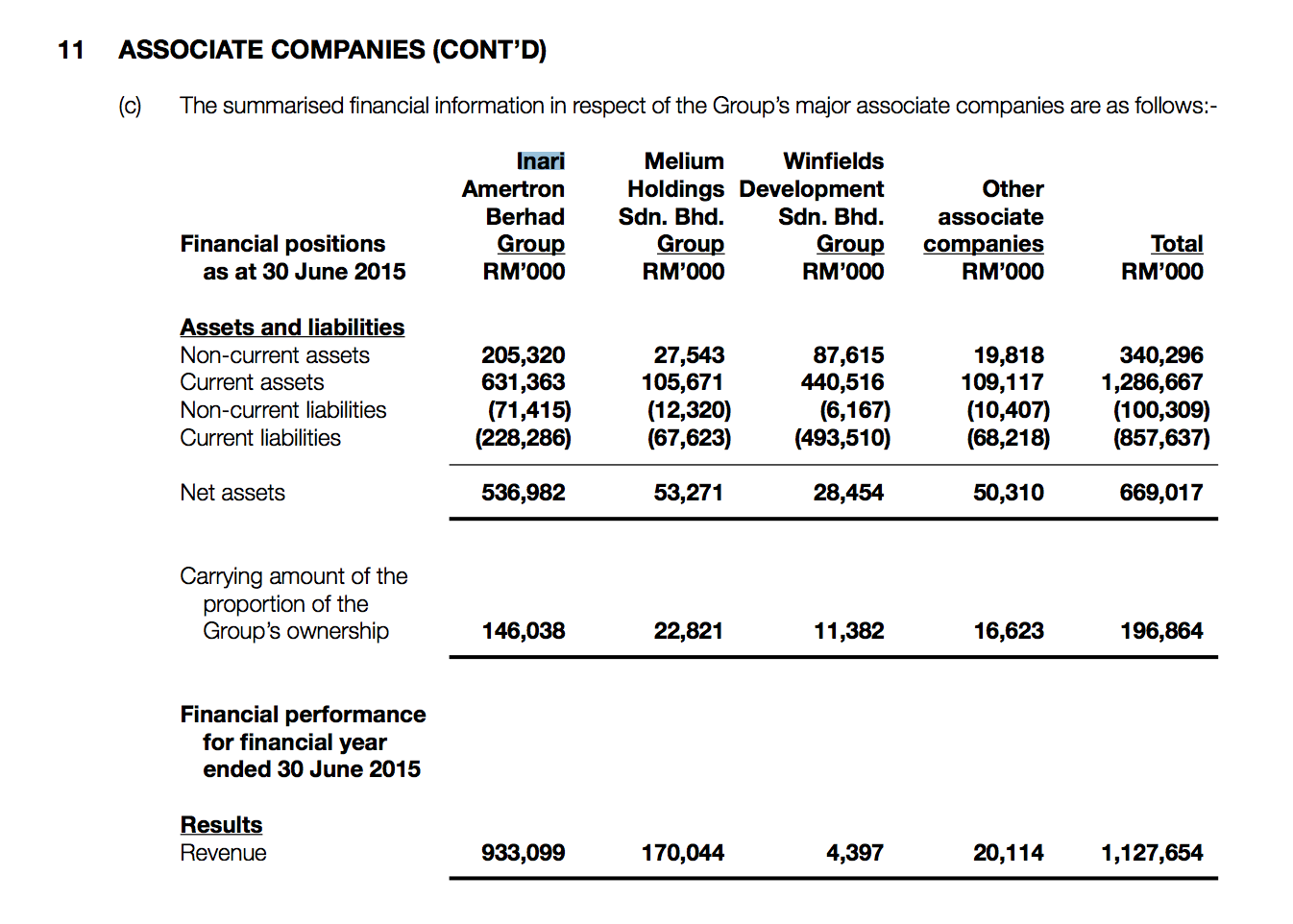
Another test in its holdings of Inari is that it does control the company as it is the single largest shareholder by far, in its accounts it is not taken as a subsidiary. It has representation by way of having 5 members / out of 9 board members in Inari. The Chairperson (Tengku Hajjah) and Executive Vice-Chairman (Tan Seng Chuan) of Inari are both from Insas.
How is this not considered a company that is controlled by Insas? I feel that the auditors have erred and did not challenge the management enough on this.
![]() |
| Treating Inari as an associate |
Thursday, April 9, 2015
No real correlation between Insas and Insas-PA (Updated)
All the 3 Insas shares made some move today (see below). While that is good for my holdings, as I do have all the 3 stocks, just wanted to highlight that there are no correlation between Insas and Insas-PA.
I have provided some background on Insas-PA here and I want to be clear again of the following characteristics of the Preference share.
IT IS NOT CONVERTIBLE INTO INSAS SHARES. Insas-PA is redeemable at RM1.00 after 5 years. This means that the company - Insas - will give you back RM1.00 for every share that you hold. If you hold 10,000 shares of Insas-PA, they will pay you RM10,000.
In addition to that, it is paying 4% of dividend every year to you as a shareholder.
The only small correlation is that investors are more confident of the redemption by Insas with the upward movement of the share price.
In addition to that, as highlighted through one of the comment, the Preference share can be used to surrender for the conversion of the warrant. This can be a useful tool in the event the Preference share is traded at below RM1.00.
The behavior of investors as they have gotten interested in the preference shares shows that the market is not efficient even in today's times when information is available almost anywhere.
On the other hand, Insas-WB has correlation to Insas as the exercise price is at RM1.00. Currently, it is out of the money - which is quite usual.
![]() |
| Share price of Insas'es as at midday 9Apr2015 |
IT IS NOT CONVERTIBLE INTO INSAS SHARES. Insas-PA is redeemable at RM1.00 after 5 years. This means that the company - Insas - will give you back RM1.00 for every share that you hold. If you hold 10,000 shares of Insas-PA, they will pay you RM10,000.
In addition to that, it is paying 4% of dividend every year to you as a shareholder.
The only small correlation is that investors are more confident of the redemption by Insas with the upward movement of the share price.
In addition to that, as highlighted through one of the comment, the Preference share can be used to surrender for the conversion of the warrant. This can be a useful tool in the event the Preference share is traded at below RM1.00.
The behavior of investors as they have gotten interested in the preference shares shows that the market is not efficient even in today's times when information is available almost anywhere.
On the other hand, Insas-WB has correlation to Insas as the exercise price is at RM1.00. Currently, it is out of the money - which is quite usual.
Wednesday, March 4, 2015
Between Insas, Keuro and TA
For those who follow or you can check out here, I do own all the three stocks - Insas, Keuro and TA Enterprise. There is one question recently, on which one does a person choose and did I buy TA and Insas because of its relative low Price/NA.
I guess if anyone choose either of these stocks or any other, it depends on ones understanding or appetite. (I do not recommend you to buy, but in many of my cases, there is a reason I buy these stocks and I usually put them down in this blog.)
Perhaps, one does not really understand why I buy many of the stocks that I picked. All three stocks have a strong margin of safety in my mind. (Have not been using this word, but perhaps the best way to describe is Graham's Margin of Safety)
Keuro - Rimbayu project I deemed to be almost valuable as in the price I paid for the entire stock, Rimbayu's value alone I see it as equivalent to Keuro which I paid for. Remember I said, WCE is a bonus and if it is successful, it is a huge bonus - enormous. I visited many times Rimbayu before I decided to buy Keuro? And yet the main jewel is not Rimbayu yet. I do not have the opportunity to visit WCE.
Insas - same thing Inari has strong value and in itself it is worth around the price I paid for Insas. And Insas has many other businesses. It has recently been purchasing, Ho Hup - I see a good angle for it to do so. And in my blog I mentioned I talked to people in Inari, and they may not know the reason for me talking to them. I also talked to people (companies) who gives projects to Inari.
TA - The foreign properties acts as a strong hedge and they could be undervalued to the books.
However, one most important trait is that they must have good growth, or if not, strong in the future. Things I can see that will make the company valuable looking forward. No point buying a business like telco (Maxis, Digi or worse still Green Packet) when I can't see growth in the future. Telco used to be a darling stock 10 - 15 years ago. Not anymore, today. (Probably only, the one telco which I see value moving forward is TimeCom. Surprise?)
In each of the stocks I picked there are something which I see valuable.
Rimbayu, WCE - good strong projects especially WCE when it is completed.
Inari - a strong business with -remember I mentioned management. But I wanted a margin of safety, which I could not get directly from Inari. Insas, as I see it today seems to be different from Insas 10 years ago. Today's Insas has a sense of direction, which is probably why they are raising funds. Insas 10 years ago, was a careful investor - no doubt good but lacked action.
TA - well, much more defensive, but they know what they are doing and they buy good properties in good locations. Basically you can see that TA is buying for the future value. Which is also why you do not see me buying a lot. It is a strong hedging stock, with decent dividends. This company listed in Bursa is quite unique as probably I cannot find a similar one (unless you buy TA Global), much more asset hedged and top up with it, is undervalued. I would say, if one is to buy gold or silver for that matter, I like TA better.
I like businesses where they go out and work for their value. Strong differentiation and value. You do not see that in both Insas and TA - but others like DKSH, Airport, NTPM, Padini (to some extent) have that.
Well, one can say I am also boring - balik-balik same stocks. There is one place where you can get daily tips and I strongly recommend, the Edgemarkets.
I guess if anyone choose either of these stocks or any other, it depends on ones understanding or appetite. (I do not recommend you to buy, but in many of my cases, there is a reason I buy these stocks and I usually put them down in this blog.)
Perhaps, one does not really understand why I buy many of the stocks that I picked. All three stocks have a strong margin of safety in my mind. (Have not been using this word, but perhaps the best way to describe is Graham's Margin of Safety)
Keuro - Rimbayu project I deemed to be almost valuable as in the price I paid for the entire stock, Rimbayu's value alone I see it as equivalent to Keuro which I paid for. Remember I said, WCE is a bonus and if it is successful, it is a huge bonus - enormous. I visited many times Rimbayu before I decided to buy Keuro? And yet the main jewel is not Rimbayu yet. I do not have the opportunity to visit WCE.
Insas - same thing Inari has strong value and in itself it is worth around the price I paid for Insas. And Insas has many other businesses. It has recently been purchasing, Ho Hup - I see a good angle for it to do so. And in my blog I mentioned I talked to people in Inari, and they may not know the reason for me talking to them. I also talked to people (companies) who gives projects to Inari.
TA - The foreign properties acts as a strong hedge and they could be undervalued to the books.
However, one most important trait is that they must have good growth, or if not, strong in the future. Things I can see that will make the company valuable looking forward. No point buying a business like telco (Maxis, Digi or worse still Green Packet) when I can't see growth in the future. Telco used to be a darling stock 10 - 15 years ago. Not anymore, today. (Probably only, the one telco which I see value moving forward is TimeCom. Surprise?)
In each of the stocks I picked there are something which I see valuable.
Rimbayu, WCE - good strong projects especially WCE when it is completed.
Inari - a strong business with -remember I mentioned management. But I wanted a margin of safety, which I could not get directly from Inari. Insas, as I see it today seems to be different from Insas 10 years ago. Today's Insas has a sense of direction, which is probably why they are raising funds. Insas 10 years ago, was a careful investor - no doubt good but lacked action.
TA - well, much more defensive, but they know what they are doing and they buy good properties in good locations. Basically you can see that TA is buying for the future value. Which is also why you do not see me buying a lot. It is a strong hedging stock, with decent dividends. This company listed in Bursa is quite unique as probably I cannot find a similar one (unless you buy TA Global), much more asset hedged and top up with it, is undervalued. I would say, if one is to buy gold or silver for that matter, I like TA better.
I like businesses where they go out and work for their value. Strong differentiation and value. You do not see that in both Insas and TA - but others like DKSH, Airport, NTPM, Padini (to some extent) have that.
Well, one can say I am also boring - balik-balik same stocks. There is one place where you can get daily tips and I strongly recommend, the Edgemarkets.
Tuesday, March 3, 2015
Insas-PA
I know most people not so keen to look at longer term (3 to 5 years). Insas Preference shares is out today traded.
It has the following profile:
- Non-Convertible;
- Redeemable at RM1 after 5 years;
- Dividend of 4% payable every half-yearly;
The preference shares is offered at RM1.00 with 2 warrants attached for every preference shares purchased.
During the last 1-1/2 months, I have been asked about what will happen to the price of the preference shares as seemingly its 4% dividend is not attractive. I knew that it would have dropped below RM1.00. In fact, I thought that RM0.90 is a good price to even purchase for those whom would want to hold it longer for the dividends and lower entry price.
Today, upon opening it dropped to RM0.795 and as at this time of writing, it is at RM0.82. Just a note at RM0.82 and with brokerage fees paid, one's return is at 8.652% for 5 years (see below).
Obviously, it is not too shabby at all, assuming we are confident that Insas can pay its dividends and repay the RM1 after 5 years. I am confident.
Think of it, if you are paying 5% for your housing loan or your car loan, do not be a smart-Alex to pay them off early.
Note: Anything that you do is at your own risk.
Just a note, at RM0.90, Insas-PA's return is at 6.43%. Well, if you look at it, is below what EPF gave last year!
Also, since I picked up 4,400 of the Insas-PA (with it attached 8,800 Insas-WB), do find the latest record on fund here.
It has the following profile:
- Non-Convertible;
- Redeemable at RM1 after 5 years;
- Dividend of 4% payable every half-yearly;
The preference shares is offered at RM1.00 with 2 warrants attached for every preference shares purchased.
During the last 1-1/2 months, I have been asked about what will happen to the price of the preference shares as seemingly its 4% dividend is not attractive. I knew that it would have dropped below RM1.00. In fact, I thought that RM0.90 is a good price to even purchase for those whom would want to hold it longer for the dividends and lower entry price.
Today, upon opening it dropped to RM0.795 and as at this time of writing, it is at RM0.82. Just a note at RM0.82 and with brokerage fees paid, one's return is at 8.652% for 5 years (see below).
![]() |
| Purchased at RM0.82 with brokerage at 0.42% |
Obviously, it is not too shabby at all, assuming we are confident that Insas can pay its dividends and repay the RM1 after 5 years. I am confident.
Think of it, if you are paying 5% for your housing loan or your car loan, do not be a smart-Alex to pay them off early.
Note: Anything that you do is at your own risk.
Just a note, at RM0.90, Insas-PA's return is at 6.43%. Well, if you look at it, is below what EPF gave last year!
![]() |
| If purchased at RM0.90 |
Friday, January 23, 2015
Insas' Rights
For those who would be wondering why Insas's share price dropped by more than 5%, it is possibly due to this as well as a 1 sen dividend (ex-date 23 Jan).
Besides the above, there are some important dates with regards to the rights, as below.
For those whom owned Insas shares prior to 23 Jan 2015, please take note of it. if you want to sell your rights, you may want to do so between 28 Jan 2015 to 5 Feb 2015. Otherwise, it is wise to pick up the Redeemable Preference Shares.
Besides the above, there are some important dates with regards to the rights, as below.
For those whom owned Insas shares prior to 23 Jan 2015, please take note of it. if you want to sell your rights, you may want to do so between 28 Jan 2015 to 5 Feb 2015. Otherwise, it is wise to pick up the Redeemable Preference Shares.
Saturday, January 3, 2015
Wednesday, December 31, 2014
Buy Insas and Sell Parkson
It is a huge mistake by me as I am behind the curve in terms of retailing. The next wave of retailing seems to be is for companies like Alibaba and Amazon. I am currently reading the book on Amazon (The Everything Store) and I came out quite impressed on the level of technology investments as well as how much changes have been made by Jeff Bezos. Similarly, I have seen interviews made to Jack Ma and I must say that these two guys will be changing the face (or already are) of retailing or how people will be buying things in the future.
This of course does not mean companies like Parkson or Aeon or even Tesco will be dead but they definitely are affected. I must say I am behind like 5 years in this as sitting in Malaysia, we are definitely not seeing the full force of the changing face of retailing. This year alone, Walmart, Tesco are affected and they are not seeing growth. Their competition are not just Sainzbury, Target but the new wave of online commerce. Obviously, Parkson which have significant businesses in China is affected and they seem to change the way they do business as rental rates seems to be tougher for these companies.
Parkson has gone towards the AEON Malaysia model, where they have started to look at owning real estates, however it seems to me they are 10 years late. I hope for Parkson, it is a case of better late than never.
Anyway, I think this is time for me to reposition my holdings and I have decided to sell Parkson taking a huge loss (percentage wise) - do not want to calculate as it is a case of me taking too much time to realise my mistake. I am just glad I did not put too much money into this.
Buy Insas
I have written a piece on this company before - in fact two as the second one is more about its holdings on Inari. The thing I wrote is still very relevant but just that fundamentally Insas has improved over the 1+ years. Inari seems to me is getting more solid by the years and I have done a careful look at Insas past and it seems to me their concentration is more on the technology sector (largely Inari's contribution) nowadays. I had the opportunity to meet one of the directors before and I must say that these are very careful and thinking people - so much so that they are really strategizing every steps they make. While they do seem to plan a lot, you hardly can go wrong with this kind of management.
In the past Insas seems to me were more dependent on its other businesses such as M&A Securities which to me is not too interesting although they do manage the business well I must say. It also had made good money in several investments such as a London property, Gleneagles KL etc. These goes to show that they are very solid investors who know what they are doing. The most recent success as mentioned was definitely Inari.
Insas is trading well below its registered book value (RM1.80/share) and for me this kind of companies they should be trading close to their book value. An investment company especially with large holdings in a securities firm will see huge swings in their profits but to me it is allright as long as they are good assets. Its current price of around RM0.80 is significantly below its book or revised book value which I can easily see at beyond RM2.00 per share. This is because it does not recognize the full market value of Inari which in terms of the holding value for Insas should be more than RM500 million. Note that Insas is now trading at around RM560 million market value - i.e. almost similar to its holding in Inari alone. Only thing is why they do not do share repurchases really beats me...
I am buying this also due to I can see there is a level of confident on Inari's future with the company calling for Redeemable Preference Shares to subscribe for the rights call by Inari. I personally feel that it must be due to there is a good mid term prospect for Inari for it to continue to expand.
As such I am buying a good 10,000 units of Insas.
Note that Insas is issuing a Redeemable Preference Shares at 1 for 5 shares held and they are also providing free warrants at 2 for 5 shares.
This of course does not mean companies like Parkson or Aeon or even Tesco will be dead but they definitely are affected. I must say I am behind like 5 years in this as sitting in Malaysia, we are definitely not seeing the full force of the changing face of retailing. This year alone, Walmart, Tesco are affected and they are not seeing growth. Their competition are not just Sainzbury, Target but the new wave of online commerce. Obviously, Parkson which have significant businesses in China is affected and they seem to change the way they do business as rental rates seems to be tougher for these companies.
Parkson has gone towards the AEON Malaysia model, where they have started to look at owning real estates, however it seems to me they are 10 years late. I hope for Parkson, it is a case of better late than never.
Anyway, I think this is time for me to reposition my holdings and I have decided to sell Parkson taking a huge loss (percentage wise) - do not want to calculate as it is a case of me taking too much time to realise my mistake. I am just glad I did not put too much money into this.
Buy Insas
I have written a piece on this company before - in fact two as the second one is more about its holdings on Inari. The thing I wrote is still very relevant but just that fundamentally Insas has improved over the 1+ years. Inari seems to me is getting more solid by the years and I have done a careful look at Insas past and it seems to me their concentration is more on the technology sector (largely Inari's contribution) nowadays. I had the opportunity to meet one of the directors before and I must say that these are very careful and thinking people - so much so that they are really strategizing every steps they make. While they do seem to plan a lot, you hardly can go wrong with this kind of management.
In the past Insas seems to me were more dependent on its other businesses such as M&A Securities which to me is not too interesting although they do manage the business well I must say. It also had made good money in several investments such as a London property, Gleneagles KL etc. These goes to show that they are very solid investors who know what they are doing. The most recent success as mentioned was definitely Inari.
Insas is trading well below its registered book value (RM1.80/share) and for me this kind of companies they should be trading close to their book value. An investment company especially with large holdings in a securities firm will see huge swings in their profits but to me it is allright as long as they are good assets. Its current price of around RM0.80 is significantly below its book or revised book value which I can easily see at beyond RM2.00 per share. This is because it does not recognize the full market value of Inari which in terms of the holding value for Insas should be more than RM500 million. Note that Insas is now trading at around RM560 million market value - i.e. almost similar to its holding in Inari alone. Only thing is why they do not do share repurchases really beats me...
I am buying this also due to I can see there is a level of confident on Inari's future with the company calling for Redeemable Preference Shares to subscribe for the rights call by Inari. I personally feel that it must be due to there is a good mid term prospect for Inari for it to continue to expand.
As such I am buying a good 10,000 units of Insas.
Note that Insas is issuing a Redeemable Preference Shares at 1 for 5 shares held and they are also providing free warrants at 2 for 5 shares.
Monday, December 9, 2013
Looking at Inari to understand Insas (Revised)
This is an update after a highlight from one of the readers. Thanks
-----------------------------------------------------------------------------------------------------------
Anyone who puts in money in Insas over the last 4 - 5 months would have made decent sum - increase from RM0.50 to now RM0.94, which coincidentally was about the period which I wrote about the company. In this particular article, I wanted to know what makes the sudden rise in the stock price whereas it has been in trading in the RM0.40 to RM0.60 for a long time.
I wanted to know what type of character are behind the owners. As in my previous article, again not much can be known except that it is led by a careful investor, Datuk Thong. To do this, I would like to take a look again at Inari. Inari is a hugely successful invested company made by Insas and I would deem it to be successfully managed by the group of management. Insas has about 36.6% of Inari and on top of that it has about 16% of its warrants. Those holdings in Inari alone is worth about RM292 million according to Inari's price todate.
Inari Amertron is involved in EMS business. Just for knowledge, the largest EMS company in the world is Foxconn or Honhai which many people know manufactures for Apple and many other companies. To provide a simple analogy, EMS is something which some technology companies do not want to deal with as many of these companies largely concentrate on the technology aspects, hence phasing out some of the work to specialised companies like Hon Hai (for Apple). Inari is such for a company called Avago.
Avago, a spin offs from the old HP company and is hugely successful in having a large penetration supplying power amplifier chips and other technologies to most of the smartphones and tablets companies. As smart phones' penetration continues to grow, Avago as expected flies. Similarly, Inari riding on that wave as a contract manufacturer for Avago is enjoying that as well to the extent that its share price becomes one of the most successful IPO of recent times.
I know that Inari is doing well. But I wanted to probe further as I also wanted to know is there any action taken to take advantage of the over-exuberance towards the company. While Avago and Inari are performing, it is a business which I am not able to gather my thoughts or foresee over the next 5 years for example. It is a business which is largely dependent on orders and contracts. Apple's iphone and ipad, and Samsung's Galaxy or HTC's line of products may be using Avago's technology now. This things, as we know can change, which is why over the longer term it is important for Inari to not be overly dependent on Avago although it has been a very good partner.
A look at its financials can be done to sometimes ascertain that.
Based on the above numbers, it is pretty solid with good revenue and PAT growth. Against its free cash flow however, Inari does not seem to be doing that strong. I can partly understand however as one will need to invest quite substantially for it to grow as a EMS player. This I believe is warranted.
I would be a little bit careful of this numbers although it is a registered audited number. Looking further into its 2Q2013 quarterly announcement, I felt that its statement was too bullish. It mentioned that its margin improved substantially due to economies of scale as provided below.
Would Inari be a good buy for the future and how about Insas? As mentioned before, Insas has some intrinsic value where as a investment company, it is doing decently well. To how much would the shareholder be providing value to its investor, that very much remains to be seen.
Inari, on the other hand would still be very dependent on Avago while Avago would be dependent on its technology for the smart phones and tablet industries. That is a lot of "IFs" I would say and looking at its share price todate, if one is to still jump in - I just have too many questions still. It is now priced at close to Globetronics market capitalisation and how it achieved this is just too strong for a EMS player.
Nevertheless, if it is able to achieve that momentum, the current traded price is still attractive.
-----------------------------------------------------------------------------------------------------------
Anyone who puts in money in Insas over the last 4 - 5 months would have made decent sum - increase from RM0.50 to now RM0.94, which coincidentally was about the period which I wrote about the company. In this particular article, I wanted to know what makes the sudden rise in the stock price whereas it has been in trading in the RM0.40 to RM0.60 for a long time.
I wanted to know what type of character are behind the owners. As in my previous article, again not much can be known except that it is led by a careful investor, Datuk Thong. To do this, I would like to take a look again at Inari. Inari is a hugely successful invested company made by Insas and I would deem it to be successfully managed by the group of management. Insas has about 36.6% of Inari and on top of that it has about 16% of its warrants. Those holdings in Inari alone is worth about RM292 million according to Inari's price todate.
Inari Amertron is involved in EMS business. Just for knowledge, the largest EMS company in the world is Foxconn or Honhai which many people know manufactures for Apple and many other companies. To provide a simple analogy, EMS is something which some technology companies do not want to deal with as many of these companies largely concentrate on the technology aspects, hence phasing out some of the work to specialised companies like Hon Hai (for Apple). Inari is such for a company called Avago.
Avago, a spin offs from the old HP company and is hugely successful in having a large penetration supplying power amplifier chips and other technologies to most of the smartphones and tablets companies. As smart phones' penetration continues to grow, Avago as expected flies. Similarly, Inari riding on that wave as a contract manufacturer for Avago is enjoying that as well to the extent that its share price becomes one of the most successful IPO of recent times.
![]() |
| Inari's price chart since IPO |
A look at its financials can be done to sometimes ascertain that.
![]() |
| PAT and GP margin for last 9 quarters |
Would Inari be a good buy for the future and how about Insas? As mentioned before, Insas has some intrinsic value where as a investment company, it is doing decently well. To how much would the shareholder be providing value to its investor, that very much remains to be seen.
Inari, on the other hand would still be very dependent on Avago while Avago would be dependent on its technology for the smart phones and tablet industries. That is a lot of "IFs" I would say and looking at its share price todate, if one is to still jump in - I just have too many questions still. It is now priced at close to Globetronics market capitalisation and how it achieved this is just too strong for a EMS player.
Nevertheless, if it is able to achieve that momentum, the current traded price is still attractive.
Tuesday, July 9, 2013
Is this not the most undervalued stock? (Updated)
Wrote this in July 2013. Now is already 1 year 9 months later. The price has rose to RM0.95 from RM0.52 when I wrote them. The company has also raised additional funds from Preference shares and puts in more money into Ho Hup and others. What more has changed?
Felicity (14 April 2015)
------------------------------------------------------------------------------------------------------
Investing for me, is about looking for great businesses. This however does not apply to everyone. Some may just want to search for companies that are undervalued to its book value. I do not specifically seek for those stocks. What I usually look for is a business which I can understand, comfortable with. Those that I can see and understand the potential - but those stocks may not be the most undervalued. In fact, it may not be undervalued at all, but as in business, you do not seek for just undervalue but good valuable companies is what you seek.
Most good businesses are usually not undervalued. Good businesses are usually trading at fair value. Seldom are we able to get them at prices which is way undervalued unless, we found those companies at its early stage.
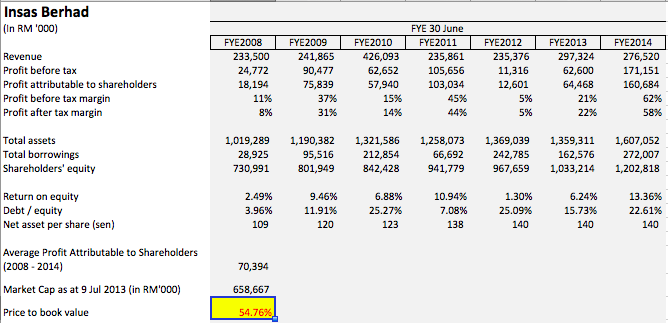
To judge a company's undervaluation based on book value though, it is much easier. A company that is trading at below its book value (with some margin of safety) is presumed to be undervalued. This applies to one particular stock which I am going to introduce as below - Insas Berhad. This company should not be difficult to value as the type of holdings that it has are in the form of investments - largely stockbroking business, Inari Amertron, Ho Hup, Omesti and several other smaller investments.
Is it not one of the most undervalued company by Price / Book Value - trading at 54.76% of its total book value?
If it is so undervalued, why is it then trading at such a valuation? No dividends, perhaps. The company in fact declared its first ever dividend of 1.3 sen last year (2013) and 1 sen each for subsequent 2 years.
Or more so the controlling parties, are contented (with what already have). To address the low price / NA, the management do some shares buyback - and in fact for certain period, they were aggressively buying back their shares. But those shares bought back were redistributed back to the shareholders in the form of share dividends - which makes me wonder on why do they do that. (I however feel that their buying back is the right thing to do rather than dividends.) Insas, should in fact do more buybacks and even at price of RM0.95 these are seriously attractive for buyback.
In terms of performance, as it mainly is an investment holding company in the areas of business which is very cyclical - stocks investment (marked to the fair value of investment), stock broking, some property investments, several IT related businesses, no one seems to be able to foresee what are the prospects or future profitability of these businesses. However, the management did manage to create value (albeit not fantastic) as shown in the growth of its total assets and equity below.
Frankly, I would not judge the company to be poorly run, but it is one of those companies which are just inaggressive where the controlling parties are just too contented with what they have. Once a while, they would have made some good investments as shown below, but these returns are kept at the group level and not shared with shareholders (usually in the form of dividends). Note: since these were written, the management has been much much more aggressive - issuing more funds to buy more businesses. They have been more aggressive in their moves i.e. investing into new companies.
One of the scenario which shows that the management have done some great work is as per below where the company has gained 80% over 3 years. These investments however are the ones which only comes once a while, and will not be contributing consistently to the company.
Part of the statement in Annual Report 2010
Last year, we reported that we made a sizeable investment in London in Chantrey House, a residential cum commercial property in the Belgravia area, a prime property location in central London. In conjunction with our UK partner, we took an equal interest in the investment amounting to 22.5 million British Pounds. Since we purchased that property, central London property prices have recovered strongly. Current prices for apartments in comparable locations are transacting at between 1,200 to 1,400 Pounds per square feet compared to our purchase price of 670 Pounds per square feet. We intend to hold on to this investment as we believe property prices should continue to rise in view of the low interest rate environment.
Part of the statement in Annual Report 2012
What is Insas core businesses then and where is its revenue and profit contribution from? Its main involvement is in the investment holding, trading and financial services and credit (money lending), and leasing (as shown below):
Investment holding as highlighted below is what they do with their cashflow, which means they trade stocks as well as buying bonds and other financial instruments:
Besides stockbroking, money lending and investments into several businesses, one noticeable investment is its associate stake in Inari, a semiconductor company which is doing extremely well. On paper, Insas' holding of 30% + warrants in Inari is already worth RM800 million as at 14 April 2015 (as compared to accounts where it is recorded at book value). Hence, the holdings in Inari is already higher than the market capitalisation of Insas and if one is to account the investments at market, the Net Asset / Share of Insas is more than RM2.50. (Is it not undervalued?)
It has also gone on to purchase the revived Ho Hup Construction, a counter which has a very interesting landbank in Sri Petaling. The property is being managed by the same party who manages Pavilion. Having said that, if it can do achieve a quarter of Pavilion is achieving, it should do well already. (It is different location though - very different)
For most part of its businesses, Insas are involved in mostly cash related trades (or businesses) which means they are liquid traded assets, hence the company should not be trading at that much below its NTA. It is not really a property company in which case the landbank may take a longer time to be disposed.
As many would have thought though (including me), Insas has been trading that way for ages, and the management is not going to change its way of handling the company. Insas has about 33,000 shareholders which means there are quite a number of holders whom are caught holding the stock for a very long time.
I do not think the management has taken the shareholders for a ride but they are surely not doing enough to take care of minorities interests.
Felicity (14 April 2015)
------------------------------------------------------------------------------------------------------
Investing for me, is about looking for great businesses. This however does not apply to everyone. Some may just want to search for companies that are undervalued to its book value. I do not specifically seek for those stocks. What I usually look for is a business which I can understand, comfortable with. Those that I can see and understand the potential - but those stocks may not be the most undervalued. In fact, it may not be undervalued at all, but as in business, you do not seek for just undervalue but good valuable companies is what you seek.
Most good businesses are usually not undervalued. Good businesses are usually trading at fair value. Seldom are we able to get them at prices which is way undervalued unless, we found those companies at its early stage.
To judge a company's undervaluation based on book value though, it is much easier. A company that is trading at below its book value (with some margin of safety) is presumed to be undervalued. This applies to one particular stock which I am going to introduce as below - Insas Berhad. This company should not be difficult to value as the type of holdings that it has are in the form of investments - largely stockbroking business, Inari Amertron, Ho Hup, Omesti and several other smaller investments.
Is it not one of the most undervalued company by Price / Book Value - trading at 54.76% of its total book value?
If it is so undervalued, why is it then trading at such a valuation? No dividends, perhaps. The company in fact declared its first ever dividend of 1.3 sen last year (2013) and 1 sen each for subsequent 2 years.
Or more so the controlling parties, are contented (with what already have). To address the low price / NA, the management do some shares buyback - and in fact for certain period, they were aggressively buying back their shares. But those shares bought back were redistributed back to the shareholders in the form of share dividends - which makes me wonder on why do they do that. (I however feel that their buying back is the right thing to do rather than dividends.) Insas, should in fact do more buybacks and even at price of RM0.95 these are seriously attractive for buyback.
In terms of performance, as it mainly is an investment holding company in the areas of business which is very cyclical - stocks investment (marked to the fair value of investment), stock broking, some property investments, several IT related businesses, no one seems to be able to foresee what are the prospects or future profitability of these businesses. However, the management did manage to create value (albeit not fantastic) as shown in the growth of its total assets and equity below.
Frankly, I would not judge the company to be poorly run, but it is one of those companies which are just inaggressive where the controlling parties are just too contented with what they have. Once a while, they would have made some good investments as shown below, but these returns are kept at the group level and not shared with shareholders (usually in the form of dividends). Note: since these were written, the management has been much much more aggressive - issuing more funds to buy more businesses. They have been more aggressive in their moves i.e. investing into new companies.
One of the scenario which shows that the management have done some great work is as per below where the company has gained 80% over 3 years. These investments however are the ones which only comes once a while, and will not be contributing consistently to the company.
Part of the statement in Annual Report 2010
Last year, we reported that we made a sizeable investment in London in Chantrey House, a residential cum commercial property in the Belgravia area, a prime property location in central London. In conjunction with our UK partner, we took an equal interest in the investment amounting to 22.5 million British Pounds. Since we purchased that property, central London property prices have recovered strongly. Current prices for apartments in comparable locations are transacting at between 1,200 to 1,400 Pounds per square feet compared to our purchase price of 670 Pounds per square feet. We intend to hold on to this investment as we believe property prices should continue to rise in view of the low interest rate environment.
Part of the statement in Annual Report 2012
I am also pleased to report that subsequent to year end, our 50% joint-controlled entity has accepted offer to sell the London’s Chantrey House property for £37.6 million, and the sale price represents a 80% capital appreciation over our original acquisition price 3 years ago. The sale, when completed, will generate free cashflow in excess of RM50 million to Insas.
What is Insas core businesses then and where is its revenue and profit contribution from? Its main involvement is in the investment holding, trading and financial services and credit (money lending), and leasing (as shown below):
Investment holding as highlighted below is what they do with their cashflow, which means they trade stocks as well as buying bonds and other financial instruments:
Besides stockbroking, money lending and investments into several businesses, one noticeable investment is its associate stake in Inari, a semiconductor company which is doing extremely well. On paper, Insas' holding of 30% + warrants in Inari is already worth RM800 million as at 14 April 2015 (as compared to accounts where it is recorded at book value). Hence, the holdings in Inari is already higher than the market capitalisation of Insas and if one is to account the investments at market, the Net Asset / Share of Insas is more than RM2.50. (Is it not undervalued?)
It has also gone on to purchase the revived Ho Hup Construction, a counter which has a very interesting landbank in Sri Petaling. The property is being managed by the same party who manages Pavilion. Having said that, if it can do achieve a quarter of Pavilion is achieving, it should do well already. (It is different location though - very different)
For most part of its businesses, Insas are involved in mostly cash related trades (or businesses) which means they are liquid traded assets, hence the company should not be trading at that much below its NTA. It is not really a property company in which case the landbank may take a longer time to be disposed.
As many would have thought though (including me), Insas has been trading that way for ages, and the management is not going to change its way of handling the company. Insas has about 33,000 shareholders which means there are quite a number of holders whom are caught holding the stock for a very long time.
As for its future, as long as it is into businesses of investing and stockbroking, it will continue to be the same i.e. pretty volatile. I feel that for it to move upwards i.e. closer to its Net Asset Value, the minority investors have to do something and voice out more so that the management take heed over the voices of the masses. Only then will it trade at its real value.
I do not think the management has taken the shareholders for a ride but they are surely not doing enough to take care of minorities interests.
Tuesday, July 10, 2012
Why I appreciate better businesses than cheap stocks
There is this quote from Warren Buffett, 'It is better to buy a great company at a fair price than a fair
company at a great price.’
If you follow my blog, I am in awe for great businesses rather than cheaper undervalued stocks. As an example, I did say I see greater heights in Nestle, while I have some reservations over RCE Capital despite its valuation is way undervalued and attractive (PE) due to some structural problems. Well, these are my opinion. Nestle's PE is about 29x while RCE's PE is around 5x. Some readers, I noticed prefer value buy - nothing wrong with that.
Now, let me tell you again why I am into great companies. Great companies are built by great business people - at least during the process of building the business, there is at least one individual why has created the DNA of a great company. See Wal-Mart (Sam Walton), Apple (Steve Jobs, of course), Genting (Lim Goh Tong) and even Coca-cola was helmed by several great individuals. Great companies can attract more investors.
Now, think of stocks as a business investment and we as investors put the trust of our decision into the hands of these businessmen. Along the way in the process of building the business, for sure they would have their hands in acquisitions, expansion, divestiture etc. A great leader may have put their skills into test by making decisions that benefit the business in doing that acquisition or divestment. Even in divestment, they would probably know when to divest a business or what their foresight would be like in business decisions that they make. The CEOs literally invest for us besides just managing the company. His / her future action is what you pay for now. Question is, are you willing to pay a premium for a great manager or are you willing to pay below average for an average manager?
Just as an example, Genting Malaysia's foray into Australia, Miami and New York's gaming business. If you are an investor of Genting, your investment is dependent on their decision making on these investments. You are investing into the management as well, not just the company and the brand. In a great company, you are investing into a company which other people are looking to invest as well. Great companies attract more attention. Additionally, owners of great businesses tend not to sell (at fair price) - especially after all the hard work of building it. On the other hand, if the business is just average, the tendency to sell would probably be higher.
Undervalued?
Now, turn it around and let's see a company which is grossly undervalued - Insas. It is now trading at RM0.41. Its book value is RM1.40, hence trading at 70% below book value. If you have invested into the company, you probably have not seen much gain. I have noticed this company for years but to be frank I am probably lucky I did not put my money into it as I was doing a sum-of-parts analysis, and it is attractive now and before. I was really attracted to the idea of buying some stocks - 7 years ago and if I had bought and held it until now, I would probably see no gain.
Let me ask you, are you going to put your money into this company now that you know it is undervalued? Bear in mind, it could have called for a delisting exercise at a slight premium to its price today. You as a minority investor would probably have no say. Again, I probably would not know what is in store for the future but if I have made my decision 7 years ago, I would not have liked it.
On the other hand, if you found a great company with undervalued prices, then you have hit a jackpot!
If you follow my blog, I am in awe for great businesses rather than cheaper undervalued stocks. As an example, I did say I see greater heights in Nestle, while I have some reservations over RCE Capital despite its valuation is way undervalued and attractive (PE) due to some structural problems. Well, these are my opinion. Nestle's PE is about 29x while RCE's PE is around 5x. Some readers, I noticed prefer value buy - nothing wrong with that.
Now, let me tell you again why I am into great companies. Great companies are built by great business people - at least during the process of building the business, there is at least one individual why has created the DNA of a great company. See Wal-Mart (Sam Walton), Apple (Steve Jobs, of course), Genting (Lim Goh Tong) and even Coca-cola was helmed by several great individuals. Great companies can attract more investors.
Now, think of stocks as a business investment and we as investors put the trust of our decision into the hands of these businessmen. Along the way in the process of building the business, for sure they would have their hands in acquisitions, expansion, divestiture etc. A great leader may have put their skills into test by making decisions that benefit the business in doing that acquisition or divestment. Even in divestment, they would probably know when to divest a business or what their foresight would be like in business decisions that they make. The CEOs literally invest for us besides just managing the company. His / her future action is what you pay for now. Question is, are you willing to pay a premium for a great manager or are you willing to pay below average for an average manager?
Just as an example, Genting Malaysia's foray into Australia, Miami and New York's gaming business. If you are an investor of Genting, your investment is dependent on their decision making on these investments. You are investing into the management as well, not just the company and the brand. In a great company, you are investing into a company which other people are looking to invest as well. Great companies attract more attention. Additionally, owners of great businesses tend not to sell (at fair price) - especially after all the hard work of building it. On the other hand, if the business is just average, the tendency to sell would probably be higher.
Undervalued?
Now, turn it around and let's see a company which is grossly undervalued - Insas. It is now trading at RM0.41. Its book value is RM1.40, hence trading at 70% below book value. If you have invested into the company, you probably have not seen much gain. I have noticed this company for years but to be frank I am probably lucky I did not put my money into it as I was doing a sum-of-parts analysis, and it is attractive now and before. I was really attracted to the idea of buying some stocks - 7 years ago and if I had bought and held it until now, I would probably see no gain.
Let me ask you, are you going to put your money into this company now that you know it is undervalued? Bear in mind, it could have called for a delisting exercise at a slight premium to its price today. You as a minority investor would probably have no say. Again, I probably would not know what is in store for the future but if I have made my decision 7 years ago, I would not have liked it.
On the other hand, if you found a great company with undervalued prices, then you have hit a jackpot!
Subscribe to:
Posts (Atom)


.png)